Planning
How to Plan a Car Audio System From Scratch
Researched from published physics, alignment relations and manufacturer specifications. Updated .
Quick answer
A car audio build goes wrong more often from sequencing than from any single bad part. Someone buys a big amplifier and a matching subwoofer because those are the exciting purchases, wires them into a factory head unit that cannot feed them a clean signal, and then finds out the factory alternator and wiring cannot support the current draw. Every piece in that stack was reasonable on its own. The order was the problem.
This guide lays out the planning sequence that avoids that trap: source first, then signal path, then amplification, then speakers, and the electrical system woven through all of it since it has to support whatever gets chosen upstream. Treatment, meaning sound deadening and sealing, belongs alongside every stage rather than as an afterthought at the end.
Why does source come before amplifier or subwoofer?
The source is whatever generates the signal, either the factory head unit through a line output converter or an aftermarket head unit with its own preouts. Everything downstream depends on what this piece can deliver. A head unit with weak preout voltage, a built-in bass rolloff at higher volumes, or no usable crossover network limits what a bigger amplifier and subwoofer can actually do with the signal they receive, no matter how much power sits behind them.
Deciding this first also answers a bigger question early: keep the factory unit and its integration, or replace it for cleaner voltage and real crossovers. That decision changes the shopping list for the rest of the system, including whether a line output converter and its wiring need a line item in the budget at all.
What is the actual build order, step by step?
| Stage | What it covers | Depends on |
|---|---|---|
| 1. Source | Factory head unit + LOC, or aftermarket head unit | Nothing upstream |
| 2. Signal | RCA routing, gain structure, DSP if used | Source preout voltage |
| 3. Amplification | Amp channel count, RMS power, class | Speaker and subwoofer impedance needs |
| 4. Speakers/subwoofer | Driver size, sensitivity, enclosure | Available space and amp power |
| 5. Electrical | Wiring, fusing, big 3, battery/alternator | Total current draw of stages 1-4 |
Convention Source: Common car audio installation sequencing. Treatment, meaning sound deadening, runs alongside every stage rather than at the end, since it is far easier to deaden a door before the speaker goes back in.
Why does the electrical system come last on paper but matter from day one?
The electrical system is planned last because its requirements are not known until everything upstream is chosen, but its cost has to be budgeted from day one. Total current draw is the sum of every amplifier's requirement, and that number is not final until the amplifier and subwoofer choices are locked in. Skipping this stage is exactly what leads to dim headlights, clipped audio, and an unplanned trip back to the parts store.
How much should electrical work cost relative to the rest of the build?
As a rough planning convention, budget 15 to 25 percent of total system cost for wiring, fusing, and any charging system upgrade on a single-amplifier build, and closer to 25 to 35 percent on a multi-amplifier build with a subwoofer drawing serious current. That range covers a wiring kit sized to the amplifier's draw, a proper main fuse, distribution if there is more than one amplifier, and a big 3 upgrade if the factory charging system is marginal.
Skipping this budget line does not remove the cost, it just defers it. A system that clips under bass, dims headlights, or trips a fuse under load almost always traces back to an electrical system sized for the factory stereo rather than the one that got installed on top of it. Running the numbers through the amp fuse calculator and alternator output calculator before buying anything else in that stage keeps the budget honest.
Where does sound deadening fit into the plan?
Sound deadening is not a stage on its own, it is work that piggybacks on whatever panel is already open. Pulling a door panel to install a component speaker is the cheapest opportunity to deaden that door's inner and outer skin, because the labor to open the door is already spent. Waiting and doing it later means opening the same panel twice.
The same logic applies to the trunk or cargo area when a subwoofer box goes in, and to the firewall if it is accessible during a head unit or amplifier install. Treatment does not need its own weekend if it rides along with work that is happening anyway.
What you need to start planning
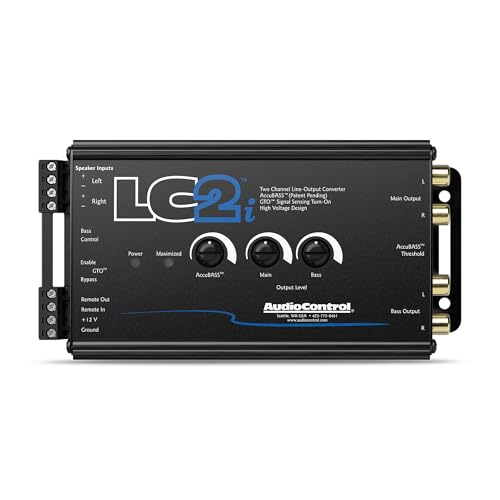
AudioControl LC2i with AccuBASS
$97.00A quality line output converter is the bridge that lets a factory head unit feed a real amplifier with a clean, adjustable signal.
Check price on Amazon
KAIWEETS automotive true RMS
$37.99A multimeter is the one tool every stage of the plan needs, from checking preout voltage to setting gain to verifying grounds.
Check price on Amazon
Kilmat 80 mil, 36 sq ft
$69.95Sound deadening mat is cheap relative to labor, so buying enough for doors and trunk up front avoids a second trip mid-build.
Check price on AmazonHow do you avoid overbuying at the start?
Write down the goal before shopping. A daily-driver upgrade that just needs clearer mids and highs calls for a different plan than a competition-style bass build, and conflating the two leads to buying amplifier channels or subwoofer power that the rest of the plan cannot use. A single 12-inch subwoofer on a well-sized amplifier satisfies most daily listening; going bigger only makes sense once that combination is confirmed to be the limiting factor, not assumed to be.
It also helps to price the electrical stage before finalizing the amplifier stage, since the two are linked. An amplifier that looks affordable on its own can push total system cost well past budget once its wiring, fusing, and possible alternator upgrade are added in.
A useful habit is pricing the whole plan twice: once with a modest amplifier and subwoofer choice, and once with the next size up, then comparing what each version actually adds in wiring gauge, fuse rating, and possible alternator work. Seeing the electrical cost jump alongside the amplifier upgrade, on paper, before either purchase happens, is often enough to settle whether the bigger amplifier is worth it for a given build. It also surfaces cases where a mid-size amplifier paired with better speakers and proper deadening beats a larger amplifier paired with nothing else changed.
Common planning mistakes
The most common mistake is buying the amplifier and subwoofer before anything else, which locks in a current draw before the electrical budget has been considered. A close second is planning speaker upgrades without checking what the source can actually deliver, which means a beautiful set of components fed by a head unit with a built-in bass rolloff and thin preout voltage. Skipping sound deadening until after panels are reassembled is a third, since it turns a five-minute add-on into a full second teardown.
Finally, treat this as a sequence with room to pause between stages, not a single purchase. A system built over a few paychecks in the right order almost always outperforms one bought all at once in the wrong order, because each stage gets sized to what actually came before it instead of a guess.
A less obvious mistake is planning every stage around a single vehicle when the vehicle itself might change before the build is finished. Amplifier and subwoofer choices are fairly portable between vehicles, but a box built to one car's trunk dimensions and a wiring run measured to one car's battery-to-amp distance are not. If a vehicle swap is even a possibility during the build, favor components and enclosure designs that are easier to adapt, and hold off on cutting a box to exact dimensions until the vehicle situation is settled.
Frequently asked questions
- What is the correct order to plan a car audio system?
- Source first, then signal path, then amplification, then speakers or subwoofer, with the electrical system sized to support whatever gets chosen at each stage. Sound deadening rides along with whatever panel is already open rather than being its own stage. Planning in this order avoids buying power the electrical system cannot support.
- Why shouldn't I just buy the amplifier and subwoofer first?
- Because their current draw determines what the wiring, fusing, and charging system need to be, and that requirement is not known until the amplifier and subwoofer are chosen. Buying them first often means discovering afterward that the electrical work costs as much as the amplifier and subwoofer combined, which is the most common budget surprise in car audio.
- How much of my budget should go toward wiring and electrical?
- As a planning convention, 15 to 25 percent of total system cost for a single amplifier, and 25 to 35 percent for a multi-amplifier or high-power subwoofer build. This covers a properly sized wiring kit, a main fuse near the battery, and a big 3 upgrade if the factory charging system is marginal for the added load.
- Should I upgrade the head unit or keep the factory one?
- Keep the factory unit if steering wheel controls, chimes, and integrated screens matter, and add a line output converter to feed an amplifier cleanly. Replace it if the factory bass rolloff at higher volume and low preout voltage are limiting the system, since an aftermarket unit gives higher voltage and real crossovers at the cost of some integration.
- When should sound deadening happen in the build?
- Whenever a panel is already open for another reason. Deadening a door while a speaker is being installed adds little labor since the panel is off anyway, while deadening it later means opening the same panel twice. The same logic applies to the trunk when a subwoofer box goes in.
- Is it better to build a system all at once or in stages?
- In stages, as long as each stage is sized correctly rather than guessed at. A system built over time in the source-signal-amplification-speakers-electrical order tends to fit its electrical system better than one bought all at once, because the electrical requirement is calculated from real components instead of assumed in advance.
Researched guidance, not professional advice. Every vehicle's factory electrical system, available space, and integration options are different, and a plan that works for one car may need adjustment for another. When a build's current draw or wiring approaches the edge of what a factory charging system can support, have it checked before it becomes a bigger repair.