Beginner

NVX
NVX XMFH48 mini-ANL holder
$9.99Forged brass in a small package, for an 8 or 4 gauge run where an ANL holder will not fit.
Check price on AmazonElectrical calculator
Quick answer
A 1,000 watt RMS class D amplifier at 80 percent efficiency draws about 87 amps at 14.4 volts. On 4 gauge wire, which is rated 85 amps, that is already too much: the same amplifier on 1/0 gauge takes a 100 amp fuse comfortably.
Result
Fit this fuse within 18 inches of the battery positive terminal. A fuse at the amplifier end protects nothing: the whole length of cable between the battery and the fuse is unprotected.
The formula
I = P_rms / (efficiency x volts), then fuse at or below the conductor ampacity
THE FUSE PROTECTS THE WIRE, NOT THE AMPLIFIER. Its job is to open before the cable can start a fire, which is why it is sized to the conductor. The amplifier has its own onboard fuses and they protect the amplifier. Fit the main fuse within 18 inches of the battery positive terminal.
The figures above are computed with these exact inputs: Amplifier RMS power 1000 W, Power wire size 1/0, Amplifier class d.
Some of these are published physics or manufacturer figures and some are conventions. They are not the same kind of number, so each one is labeled.
| Assumption | Kind | Where it comes from |
|---|---|---|
| Class D Efficiency: 0.8 | Convention | A planning efficiency for a class D mobile amplifier at typical listening levels. Real efficiency varies with load impedance, output level and the amplifier itself, and no standards body publishes a single figure |
| NEC Table 310.16 | Published figure | NEC Table 310.16, 75 C copper |
| Overcurrent protection sizes to the conductor | Published figure | Overcurrent protection sizes to the conductor, not the load. The same principle as NEC 240.4: a fuse protects the wire it is connected to |
| Fuse Distance18in: 18 | Published figure | The 18 inch main fuse distance is the figure published in mobile electronics installation practice and mirrored by ABYC E-11, which requires overcurrent protection within 7 inches of the battery for boats and allows longer runs only in sheathed conduit |
Every card below is in the page source. The calculator re-ranks them against your numbers and marks anything that falls short of what you just calculated.
Forged brass in a small package, for an 8 or 4 gauge run where an ANL holder will not fit.
Check price on Amazon
A complete inline ANL holder and fuse at under ten dollars, which removes every excuse for skipping the main fuse.
Check price on Amazon
Two holders and two 100 amp fuses, which suits a pair of small amplifiers fused separately.
Check price on Amazon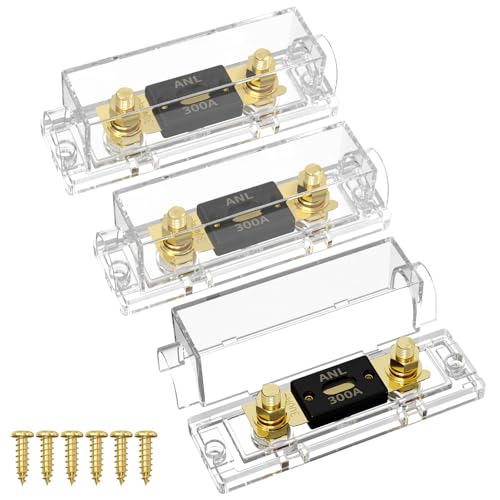
Three holders, which covers the battery end, the distribution end and a spare.
Check price on Amazon
A sealed pro series holder that takes 1/0 or 4 gauge without an adapter.
Check price on Amazon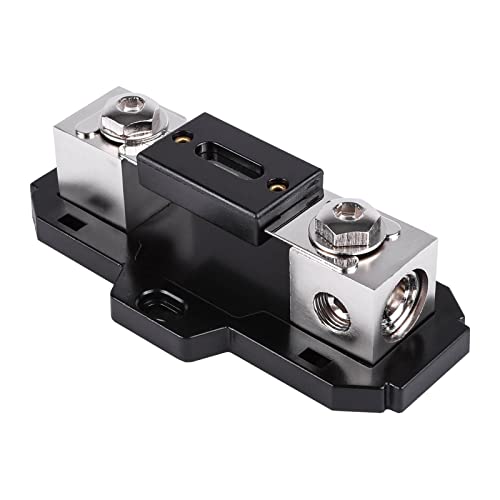
A 250 amp fuse is the usual match for 1/0 gauge, which is what most high power single amplifier runs use.
Check price on AmazonResearched guidance, not professional advice. These results are planning figures from published relations and manufacturer specifications. Fit the main fuse within 18 inches of the battery positive terminal, because that fuse protects the wire and the wire is what starts a fire. Disconnect the battery before running power wire, use a grommet through every piece of sheet metal, and remember that sustained high sound pressure causes permanent hearing damage.