Beginner
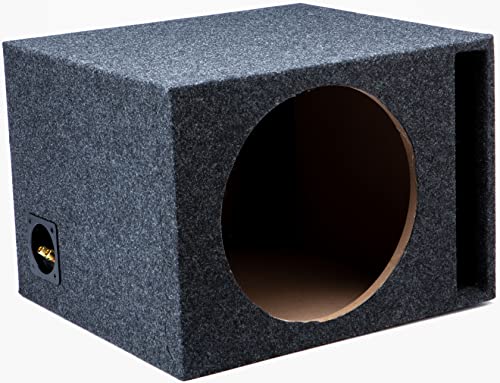
American Sound Connection
ASC single 12 ported box
$54.95A plain 5/8 inch MDF vented box, which is the cheapest starting point if you are not building your own.
Check price on AmazonEnclosure calculator
Quick answer
The QB3 vented alignment gives Vb = 20 x Vas x Qts^3.3, tuned to Fb = 0.42 x Fs x Qts^-0.96. A driver with Vas of 1.2 cubic feet, Qts of 0.42 and Fs of 32 Hz wants about 1.7 cubic feet tuned near 31 Hz.
Result
This is NET volume after the port and the driver are subtracted. Work out the port next, then add its displacement back into the box you build.
The formula
Vb = 20 x Vas x Qts^3.3, Fb = 0.42 x Fs x Qts^-0.96, F3 = 0.26 x Fs x Qts^-1.4
QB3 only describes a useful vented box over roughly Qts 0.2 to 0.5. Outside that range this returns nothing rather than a number that looks authoritative and is not. A driver with a Qts above 0.5 generally wants a sealed box.
The figures above are computed with these exact inputs: Vas 1.2 cu ft, Qts 0.42, Fs 32 Hz.
Some of these are published physics or manufacturer figures and some are conventions. They are not the same kind of number, so each one is labeled.
| Assumption | Kind | Where it comes from |
|---|---|---|
| Thiele and Small vented-box alignment approximations | Published figure | Thiele and Small vented-box alignment approximations, quasi-Butterworth third order (QB3) |
Every card below is in the page source. The calculator re-ranks them against your numbers and marks anything that falls short of what you just calculated.
A plain 5/8 inch MDF vented box, which is the cheapest starting point if you are not building your own.
Check price on Amazon
A universal fit vented 12 box with UV treated carpet, aimed at a hatch or trunk install.
Check price on Amazon
A side ported design, which packages into a trunk corner better than a front ported box of the same volume.
Check price on Amazon
The long running QBomb vented design, and one of the few boxes at this price with a stated internal volume.
Check price on Amazon
A stated 2.0 cubic feet, which is the figure to check against your driver before buying any prebuilt box.
Check price on Amazon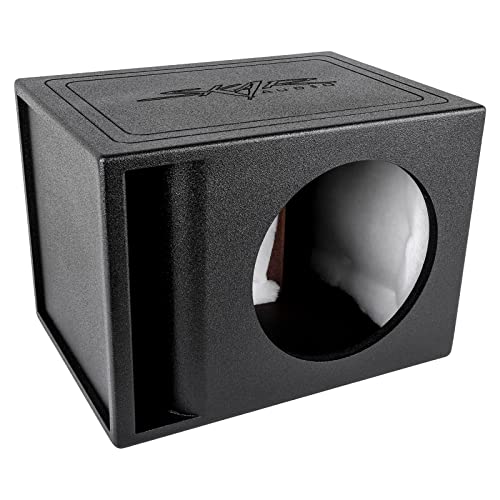
An armor coated box with a kerf port, which survives a truck bed and a move far better than carpet over MDF.
Check price on AmazonResearched guidance, not professional advice. These results are planning figures from published relations and manufacturer specifications. Fit the main fuse within 18 inches of the battery positive terminal, because that fuse protects the wire and the wire is what starts a fire. Disconnect the battery before running power wire, use a grommet through every piece of sheet metal, and remember that sustained high sound pressure causes permanent hearing damage.