Electrical
What Alternator Output for a 500 Watt System?
Researched from published physics, alignment relations and manufacturer specifications. Updated .
Quick answer
An alternator is the only part of a car audio electrical system that actually makes energy. Everything else stores it or moves it. That is why the alternator is the real answer to voltage sag and a capacitor is not.
A 500 watt system draws about 43.4 amps at rated output, computed from RMS watts / (efficiency x volts) with a class D efficiency of 80 percent, which is a convention rather than a published figure. Your vehicle's own accessories add to it. Work it out for your case with the alternator output calculator.
How many amps does a 500 watt system need?
The answer depends on the vehicle as much as on the audio, because the vehicle's own electrical load is a real share of the total.
| Vehicle | Accessory load | Audio draw | Alternator needed |
|---|---|---|---|
| small car, few accessories | 35 A | 43.4 A | 95 A |
| typical car with headlights, blower and heated glass | 55 A | 43.4 A | 119 A |
| truck or SUV with heated seats, lights and a winch circuit | 80 A | 43.4 A | 149 A |
Convention Source: Accessory load figures and the 20 percent charging headroom are planning conventions. The audio draw is computed from rated power and a class D efficiency convention. The vehicle electrical schematic is the authority on accessory load. These are planning figures for a system that has not been measured.
Idle output is the number that matters
A peak output figure tells you almost nothing useful. An alternator rated 300 amps at 6,000 alternator rpm may make well under a third of that at engine idle, and engine idle is exactly when you are sitting at a stoplight with the bass up. Manufacturers that publish an output curve across the rpm range are telling you something the ones publishing a single peak number are not. Ask for the idle figure before you spend the money.
What has to change alongside the alternator
A larger alternator makes more current, and that current has to get to the battery through the factory charging cable. On most vehicles that cable was sized for the factory alternator, so the big 3 upgrade is not optional once you fit a high output unit: it is the thing that lets the new alternator deliver what it makes.
Fuse the alternator output run near the alternator. The pulley ratio may also need attention, because several high output units ship with a smaller pulley to raise alternator rpm at idle and that requires a shorter belt. Read the installation note on the listing rather than discovering this with the car in pieces.

Sky High E-Series big 3, CCA
$32.95The cheapest way to do the big 3 properly, and copper clad aluminum at 1/0 still beats factory 6 gauge by a wide margin.
Check price on Amazon
True Spec oversized 1/0 OFC big 3
$82.99Oxygen free copper at a price closer to the CCA kits than most OFC options.
Check price on Amazon
Sky High 1/0 OFC big 3
$96.95Pre-terminated OFC in red and black, which saves buying lugs and a crimper for a first upgrade.
Check price on AmazonDo you need a second battery as well?
A second battery adds reserve, not supply. It helps when the demand is short and the alternator can refill it afterwards, and it does nothing at all for a system that is continuously drawing more than the alternator makes. On a 500 watt system the sensible order is the big 3 first, then the alternator, then a second battery, with a capacitor last if at all.
If you do add one, use a deep cycle AGM power cell rather than a starting battery. Anything rated in cold cranking amps is built for a short, huge burst and is damaged by the repeated deep discharge an amplifier rack puts it through.
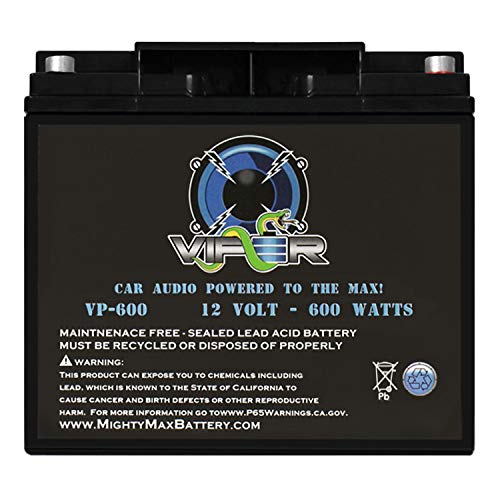
Mighty Max Viper VP-600
$44.99An 18 amp hour power cell at under fifty dollars, which is the cheapest real second battery here.
Check price on Amazon
DS18 INF-18
$77.95Eighteen amp hours in a compact case, which fits under a rear seat where a group 34 will not.
Check price on Amazon
XS Power XP750
$119.99XS Power publishes real specifications, and the XP750 is the usual first supplemental battery.
Check price on AmazonFitment is not optional
Every high output alternator is vehicle specific. The bracket, the pulley, the plug and the case all have to match your engine, and the units in this catalog fit only certain listed GM trucks and SUVs. Check the fitment list against your own year, engine and body before ordering. We cannot tell you whether a given unit fits your vehicle, and any site that says it can without knowing your VIN is guessing.
High output alternators, all vehicle specific

Mechman 390A for GM trucks
$449.00Mechman publishes output at idle rather than only a peak figure, which is the number that matters at a stoplight.
Check price on Amazon
Mechman 390A black finish
$479.00The same unit in black, for an engine bay that has been detailed.
Check price on Amazon
Mechman 400A for 2014 to 2018 GM trucks
$549.00Four hundred amps, and a shorter serpentine belt is required. Do not order it without reading the installation note.
Check price on Amazon
Mechman 400A for 1996 to 2004 GM trucks
$549.00The earlier truck fitment at the same output.
Check price on AmazonFrequently asked questions
- What size alternator do I need for 500 watts?
- About 119 amps total output, assuming a typical 55 amp vehicle accessory load and 20 percent headroom so the battery still charges. The audio itself accounts for roughly 43.4 amps. Check the output at idle rather than the peak figure, because a peak rating at high rpm says nothing about the stoplight where you actually notice the problem.
- Is my stock alternator enough?
- A stock passenger car alternator typically makes 90 to 150 amps at cruising rpm and considerably less at idle, and the vehicle's own accessories take a sizeable share before the audio gets any. Up to about 1,000 watts of class D audio, a stock alternator plus the big 3 upgrade is often enough. Beyond that the arithmetic stops working.
- Will a high output alternator hurt my vehicle electronics?
- No. An alternator supplies the current that is demanded of it rather than forcing current into the system, so a larger unit at the same regulated voltage changes nothing for the factory electronics. What does need attention is the charging cable, which was sized for the factory alternator, and the belt, since higher output means more mechanical load.
- Do I need the big 3 upgrade with a new alternator?
- Yes, in practice. The factory alternator-to-battery cable, the battery-to-chassis ground and the engine-to-chassis strap were all sized for the original output. Fitting a much larger alternator behind the original cabling means the extra current cannot get anywhere. The big 3 is cheap relative to an alternator and it is the thing that makes the alternator useful.
- How do I know what my current alternator makes?
- It is usually stamped on the case or printed on a label, and it is listed in the vehicle service data. Be aware that the stamped figure is a peak rating at high rpm. The practical test is a multimeter across the battery terminals with the engine running and the system at volume: if it drops below about 12.8 volts, the charging system is losing the argument.
12V safety. A car battery will deliver several hundred amps into a short circuit without any drama at all, which is why the main fuse goes within 18 inches of the battery positive terminal. That fuse protects the wire, not the equipment: the length of cable between the battery and the fuse is unprotected, so a fuse at the amplifier end protects nothing. Disconnect the battery negative before you run power wire, and fit a rubber grommet anywhere a cable passes through sheet metal, because a bare edge will eventually cut through insulation.