Tuning
Dayton Audio DSP-408 Review: Time Alignment for the Rest of Us
Researched from published physics, alignment relations and manufacturer specifications. Updated .
Quick answer
A digital signal processor sits between the source unit and the amplifiers in a car audio system, and its job is to solve problems that better speakers or a bigger amplifier cannot fix on their own. The Dayton Audio DSP-408 handles four inputs and eight outputs, with onboard equalization, active crossovers, time alignment, and input mixing, which puts it in the category of processors built for systems with several amplified channels rather than a single stereo pair.
This page is compiled from Dayton Audio's published specification sheet, the printed owner manual, and the consensus of verified owner reviews and tuning writeups. Nobody on this team has installed, measured, or listened to this specific unit, so the notes below reflect documented features and owner-reported tuning experience, not a hands-on session.
What are the published specifications?
| Specification | Value |
|---|---|
| Inputs | 4 |
| Outputs | 8 |
| Equalization | Built-in equalization per channel |
| Crossovers | Built-in active crossover control per output |
| Time alignment | Built-in, per-channel |
| Input mixing | Supported |
Published figure Source: Manufacturer published specifications. Beyond the feature list Dayton Audio publishes, we did not find a detailed control interface or software requirement spelled out in the material we reviewed for this page. Confirm the tuning software and connection method, and whether a laptop is required during setup, directly with the current manual before you buy.
What does time alignment actually fix?
In a home stereo, both speakers are usually the same distance from the listener. In a car, that is almost never true: the driver typically sits close to the left door speaker and considerably farther from the right side, and even farther still from any speakers behind the front row. Sound from the near speaker arrives at your ears before sound from the far speaker, even though both were sent from the source unit at the same moment, and that timing gap smears the stereo image toward the closer side.
Time alignment corrects this by digitally delaying the signal to the closer speakers by a few milliseconds so that all channels arrive at the listening position together. The DSP-408 includes this feature per channel across its eight outputs, which is the specific capability that lets a processor like this pull a stereo image toward the center of the dashboard instead of collapsing it toward whichever door is closest to the driver.
Does a DSP replace the need for a signal chain that is already set up correctly?
A processor sits inside an existing signal chain, it does not replace correct gain staging. Adding the DSP-408 means you now have gain and level settings at the source unit, at the processor's input stage, and at each amplifier the processor feeds, and each stage needs to be set correctly in sequence rather than cranked up individually to compensate for a weak link elsewhere. Skipping careful gain staging at any of those points can introduce noise or distortion that no amount of equalization or time alignment inside the DSP will fix, since those tools shape tone and timing, not signal-to-noise ratio.
Does a DSP replace the need for better speakers?
No. A processor like the DSP-408 addresses timing, tonal balance, and how signals are split and mixed across your outputs; it does not change what a speaker's cone or voice coil is physically capable of. A speaker with cone breakup at high volume or a fundamentally limited frequency response will still show those limits with a DSP in the chain, just with better timing and EQ around them. Where a DSP earns its keep is in taking an already-decent set of speakers and amplifiers and making them work together properly as a system, particularly on the imaging problem that no single speaker upgrade can solve by itself.
What does eight outputs actually enable in a build?
Four inputs and eight outputs gives you enough channels to actively drive a multi-way front stage, for example separate amplifier channels for tweeters, midrange, and woofers, while still having outputs left over for rear fill or a subwoofer, all from a single processor rather than stacking passive crossovers on top of active ones. This is the kind of channel count that matters once a build grows past a basic component set and a subwoofer amp, and it is the main reason to reach for a processor at this size instead of a simpler two or four channel unit.
Who should not buy the Dayton Audio DSP-408?
If your system is a factory head unit driving a single set of component speakers and maybe a subwoofer, an eight-output processor is more channels and more tuning complexity than that build needs; a simpler two or four channel DSP, or no DSP at all, may serve you better. Skip it too if you are not prepared to spend real time in the tuning software, since time alignment and per-channel crossover points require deliberate setup to deliver their benefit, and a processor left on default settings will not automatically outperform a simpler system. It is best suited to builds with three or more amplified channel groups where the imaging and integration benefits actually have something to work with.
What else to consider

PRV Audio DSP 2.4X
$54.00A processor to compare channel count and feature set against if your build needs fewer than eight outputs.
Check price on Amazon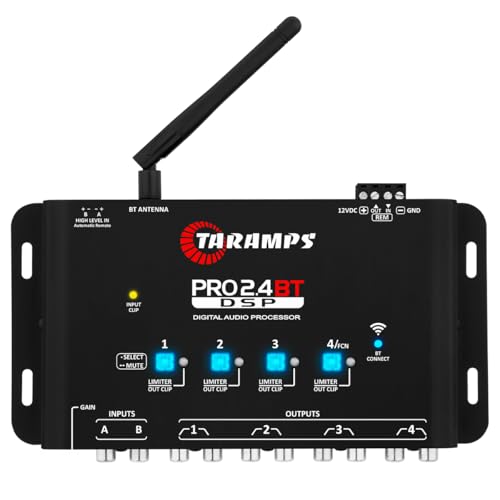
Taramps Pro 2.4 BT
$59.00Adds Bluetooth input handling worth comparing if you want wireless source flexibility alongside DSP tuning.
Check price on Amazon
Hertz SPL Show S8 DSP
$419.99A higher-tier eight-channel processor to cross-shop against if you want more advanced tuning tools for a similar channel count.
Check price on Amazon
B2 Audio 4v 10 channel
$138.90A smaller channel count option worth considering if an eight-output processor is more than your current amplifier lineup needs.
Check price on AmazonFrequently asked questions
- What does the DSP-408's four input, eight output layout mean in practice?
- It means the unit can accept up to four source signals, for example a head unit's front and rear outputs, and distribute processed audio across eight separate amplifier channels. That output count supports builds with multiple amplified sections, such as an actively crossed-over front stage plus rear fill and a subwoofer, from a single processor.
- Why does time alignment matter more than a better speaker for imaging?
- Imaging problems in a car come from the driver sitting closer to one speaker than another, so sound arrives at different times from each side. That is a timing problem, not a speaker quality problem, and no speaker upgrade corrects it. Time alignment delays the near-side channels so all speakers arrive together, which is what actually repositions the image.
- Do I need a laptop to tune the DSP-408?
- Dayton Audio's feature list confirms built-in equalization, crossovers, time alignment, and input mixing, but we did not find a detailed description of the connection and software workflow in the material reviewed for this page. Check the current owner manual for the specific tuning interface and whether a computer connection is required during setup.
- Can a DSP fix a speaker that sounds harsh at higher volume?
- It can help by rolling off problem frequencies with its built-in equalization and crossovers, but it cannot change the physical cause of harshness, such as cone breakup inside a speaker's voice coil or suspension. A DSP shapes what signal reaches a speaker; it does not alter what that speaker is mechanically capable of reproducing cleanly.
- Is eight channels overkill for a basic two-speaker-and-a-sub system?
- For that simpler layout, yes, in most cases. Eight outputs are built for systems actively driving several amplifier sections, such as a multi-way front stage plus rear fill and a subwoofer. A basic build with one set of component speakers and a sub will not use most of that channel count and may be better served by a smaller processor.
- Does adding a DSP mean I need to redo my amplifier gain settings?
- Generally yes. Inserting a processor into the signal chain adds a new input and output level to manage between the source unit, the DSP, and each amplifier. Setting each stage's gain correctly in sequence, rather than compensating for one stage by overdriving another, is necessary to avoid added noise or distortion once the DSP is in place.
Researched guidance, not professional advice. This review is compiled from Dayton Audio's published specifications and the consensus of verified owner tuning writeups, not from an installation or tuning session performed by this site. Confirm software requirements and channel routing against the current manual before purchasing.