Reference
Wire Gauge Ampacity Chart: NEC Ratings for Car Audio Power Wire
Researched from published physics, alignment relations and manufacturer specifications. Updated .
Quick answer
Every amplifier install starts with the same question: what gauge wire actually handles this amplifier's current draw. The NEC ampacity table is the closest thing car audio has to an agreed-upon answer, even though it was written for household branch circuits rather than 12-volt systems, because it is a published, checkable number rather than a marketing claim printed on a wire spool.
This chart lays out the full copper ampacity and resistance table from 18-gauge to 4/0-gauge, adjusts for copper-clad aluminum, and translates both into the gauge sizes installers actually reach for at each power level. Pair it with the amp wire gauge calculator for a number specific to your amplifier and run length.
Bookmark this page as the single source both the current draw chart and the fuse size chart on this site pull their gauge-to-ampacity numbers from, since keeping every reference tied to the same underlying table is what keeps them consistent with each other.
What is the NEC ampacity rating for each wire gauge?
Every number below comes from the two NEC tables installers already lean on: Chapter 9 Table 8 for resistance, and Table 310.16 for ampacity, both for uncoated stranded copper at 75 C. Together they double as a wire size cheat sheet and a resistance reference for the voltage drop math used elsewhere on this site.
| Gauge | Resistance (ohms per 1,000 ft) | Ampacity at 75 C |
|---|---|---|
| 18-gauge | 7.95 | 14A |
| 16-gauge | 4.99 | 18A |
| 14-gauge | 3.14 | 20A |
| 12-gauge | 1.98 | 25A |
| 10-gauge | 1.24 | 35A |
| 8-gauge | 0.778 | 50A |
| 6-gauge | 0.491 | 65A |
| 4-gauge | 0.308 | 85A |
| 2-gauge | 0.194 | 115A |
| 1-gauge | 0.154 | 130A |
| 1/0-gauge | 0.122 | 150A |
| 2/0-gauge | 0.0967 | 175A |
| 4/0-gauge | 0.0608 | 230A |
Published figure Source: NEC Chapter 9 Table 8 (resistance) and NEC Table 310.16 (ampacity), uncoated stranded copper at 75 C. Resistance drives voltage drop over distance, and ampacity sets the ceiling before the insulation overheats. A wire can pass the ampacity test and still drop too much voltage on a long run, which is why the two figures answer different questions.
Why does this rating look conservative for a car audio wire?
The NEC Table 310.16 ampacity figures are conservative for most car audio installs. That table assumes 75 C insulation bundled with other current-carrying conductors inside a raceway, a worse thermal environment than a single power wire routed in open air along a vehicle's interior. Most car audio power wire also carries higher-temperature insulation than the table assumes. Real installs generally carry more current than the published number allows, but the reader's actual insulation rating is rarely printed on the jacket, so this chart uses the conservative, checkable NEC figure rather than guessing at a higher one.
How much does copper-clad aluminum change the gauge you need?
Copper-clad aluminum shows up in budget wiring kits because it costs less and weighs less than solid copper, but it pays for that with meaningfully higher resistance at the same physical gauge. The table below is a sizing convention, not a published equivalency standard, for stepping a CCA spec up enough to close most of that gap.
| If the copper spec calls for | CCA equivalent gauge | Why |
|---|---|---|
| 8-gauge copper | 6-gauge CCA | Closes most of the resistance gap at a common amplifier-feed size |
| 4-gauge copper | 2-gauge CCA | One size up compensates for roughly 60 percent conductivity |
| 2-gauge copper | 1-gauge or 1/0-gauge CCA | Higher-current runs benefit from a full two-size step up |
| 1/0-gauge copper | 2/0-gauge CCA | Keeps resistance close to copper on a big 3 or main power run |
Convention Source: CCA rated at approximately 60 percent of copper's conductivity for the same cross section, standard installer sizing convention. This is a sizing convention, not a published equivalency table. On a high-current run, sizing CCA two full gauge steps larger than the copper spec keeps resistance closer to copper's.
What gauge should you actually run for a given amplifier?
This table starts from the same class D current draw convention used throughout this site, 80 percent efficiency at a nominal 14.4 volts, then checks that current against the ampacity table above. The right-hand column reflects what installers commonly run once a modest run length and a bit of headroom enter the picture.
| RMS watts | Current draw (class D, 80% efficiency) | Minimum gauge by ampacity alone | Gauge typically used |
|---|---|---|---|
| 200W | 17.4A | 16-gauge | 10-gauge |
| 400W | 34.7A | 10-gauge | 8-gauge |
| 600W | 52.1A | 6-gauge | 4-gauge |
| 800W | 69.4A | 4-gauge | 4-gauge |
| 1,000W | 86.8A | 2-gauge | 2-gauge |
| 1,500W | 130.2A | 1/0-gauge | 1/0-gauge |
| 2,000W | 173.6A | 2/0-gauge | 2/0-gauge |
Convention Source: Current draw from I = watts / (0.80 x 14.4 volts), a class D efficiency convention, matched to NEC Table 310.16 ampacity minimums. The gauge typically used runs one step heavier than the ampacity minimum at lower power levels, since a longer run's voltage drop becomes the real limit before ampacity does. Check your own run length against the voltage drop chart before finalizing.
Resistance versus ampacity: two different limits
Ampacity answers one question: how much current can this wire carry before the insulation overheats. Resistance answers a completely different one: how much voltage does the wire lose to the trip itself, independent of whether it overheats. A 4-gauge wire rated for 85 amps can carry a 60-amp amplifier all day without heat trouble, and still drop more voltage than a builder wants if that run stretches 20 feet from a trunk-mounted battery to a front-mounted amplifier.
As a quick example, running 4-gauge wire (0.308 ohms per 1,000 feet) 15 feet one way at 60 amps loses about 0.55 volts round trip, under 4 percent of a nominal 14.4-volt system, comfortably inside the wire's 85-amp ampacity rating the whole time. Stretch that same run to 25 feet and the drop climbs past 0.9 volts even though the ampacity rating never changes, which is the exact gap this chart cannot close by itself. Pair the ampacity minimum here with the run-length math in the voltage drop chart before finalizing a gauge on anything longer than a few feet.
How much margin should you build in beyond the minimum?
Build in margin wherever the wire runs somewhere hotter than the rest of the vehicle, such as near an engine bay, an exhaust tunnel, or bundled tightly with several other current-carrying cables. Heat and bundling both reduce a wire's real-world ampacity below the table figure, which assumes reasonably free airflow around a single conductor. A run that passes through a warm engine bay before reaching the cabin is a good candidate for stepping up one gauge size beyond the minimum this chart lists.
Connector and terminal resistance adds up too, and it does not show up in either the ampacity or resistance figures above, since those describe the wire alone. Every crimped ring terminal, every fuse holder, and every distribution block junction adds a small amount of resistance on top of the wire's own number. On a system with several such connections in series, a wire sized right at the calculated minimum can still underperform a wire sized one step larger, simply because the extra junctions were never part of the original math.
The gauge that clears every test on paper is still worth double-checking once the wire is actually in hand. Bargain spools sometimes ship thinner than their labeled gauge, and a caliper check on the bare copper strands against a published wire diameter chart takes a minute and catches a mislabeled spool before it goes anywhere near a fuse holder.
Gear for this

GearIT 1/0 OFC, 25 ft red
$142.991/0-gauge power wire covers the higher end of this chart's typical-use column for larger amplifier systems.
Check price on Amazon
DS18 AMPKIT4
$54.95A complete 4-gauge kit matches the gauge most 600 to 900 watt systems land on in the table above.
Check price on Amazon
haisstronica lug and heat shrink kit
$15.99Correctly sized ring terminals keep the connection itself from adding resistance on top of the wire's own rating.
Check price on Amazon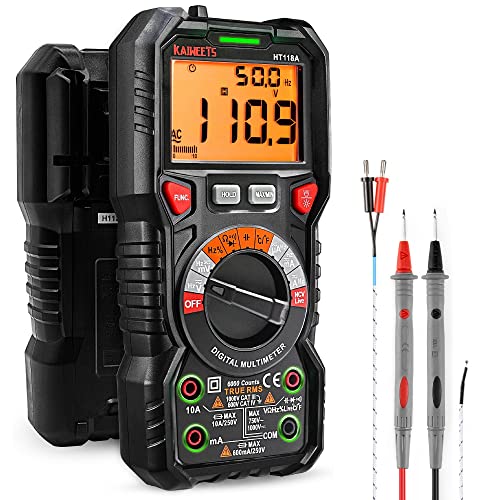
KAIWEETS automotive true RMS
$37.99A multimeter lets you verify continuity and check for shorts before trusting any calculated gauge in a live system.
Check price on AmazonFrequently asked questions
- What gauge wire is rated for 100 amps?
- No single gauge in NEC Table 310.16 lands exactly at 100 amps. 2-gauge copper is rated for 115 amps and 4-gauge is rated for 85 amps at 75 C, so a 100-amp draw needs 2-gauge as the minimum by ampacity alone. Factor in run length too, since a long run can push the practical choice up to 1-gauge or 1/0-gauge even though 2-gauge technically clears the ampacity bar.
- Is the NEC ampacity chart accurate for car audio wiring?
- It is accurate as a conservative floor. NEC Table 310.16 assumes 75 C insulation bundled in a raceway, a worse thermal situation than most single power wires running in open air inside a vehicle. Real car audio wire typically carries higher-temperature insulation and handles more current than the table allows, but the published figure is the only universally checkable number, which is why it remains the standard reference.
- Does copper-clad aluminum wire need a bigger gauge than copper?
- Yes. CCA conducts at roughly 60 percent of copper's rate in the same gauge, so a CCA cable needs to be sized one to two gauge steps larger to match copper's resistance and current-carrying performance. An 8-gauge copper spec becomes 6-gauge CCA, and a 1/0-gauge copper spec becomes roughly 2/0-gauge CCA for comparable results.
- What is the difference between ampacity and voltage drop?
- Ampacity is the maximum current a wire can carry before its insulation overheats, a heat and safety limit. Voltage drop is the amount of voltage lost to the wire's own resistance over a given distance, a performance limit. A wire can pass the ampacity test easily and still lose more voltage than a builder wants over a long run, so both figures matter, not just one.
- Can I use 8-gauge wire for a 1,000 watt amplifier?
- Not by itself. A 1,000 watt RMS amplifier at typical class D efficiency draws roughly 87 amps, well above 8-gauge copper's 50-amp ampacity rating at 75 C. 2-gauge wire, rated for 115 amps, is the minimum gauge that clears both the ampacity and typical voltage drop requirements for that power level on most runs.
- Why do some online charts list higher amperage for the same wire gauge?
- Different charts often use different assumptions: some use a higher insulation temperature rating, some assume free air rather than a bundled raceway, and some are not sourced from a published standard at all. This chart uses NEC Table 310.16 at 75 C specifically so every figure traces back to a single, checkable source rather than a mix of assumptions.
Researched guidance, not professional advice. Published ampacity and resistance figures come from NEC tables built for household wiring, and real-world car audio installs vary by insulation type, routing, and run length. Confirm your specific wire's rating with its manufacturer before wiring a high-current system.