Reference
Voltage Drop Chart for 12-Volt Car Audio Wiring
Researched from published physics, alignment relations and manufacturer specifications. Updated .
Quick answer
Voltage drop is not about whether a wire can carry the current, it is about how much of the battery's voltage survives the trip to the amplifier and back. Every foot of wire has resistance, and every amp of current pushed through that resistance turns a small amount of voltage into heat before it ever reaches the amplifier's power terminal.
The formula behind every number on this page is simple once the return path is accounted for: voltage drop equals two times the one-way distance times the current times the wire's resistance per foot. That factor of two catches people constantly, since it is easy to plug in the one-way run and forget that the ground path back to the battery adds the same resistance again, and it is the single detail that separates a correct calculation from one that quietly understates the real loss by half.
The tables below turn that formula into a lookup: drop by gauge across several currents, drop by run length at a fixed current, and a plain-language read on what percentage of drop actually matters. Every figure traces back to the same two inputs, the wire's published resistance and the current it carries, so the math never depends on a specific brand of cable.
How do you calculate voltage drop for a 12-volt run?
The formula is Vdrop = 2 x one-way feet x amps x (ohms per 1,000 feet / 1,000). The 2 accounts for the full circuit: current travels down the power wire to the amplifier, then back through the ground wire to the battery, and both legs add resistance. Drop percent is the voltage drop divided by a nominal 14.4-volt charging system, multiplied by 100.
As a worked example, 2-gauge wire (0.194 ohms per 1,000 feet) carrying 100 amps over a 15-foot one-way run loses 2 x 15 x 100 x (0.194 / 1,000) = 0.582 volts, about 4.0 percent of 14.4 volts. Halve the run to 7.5 feet and the drop halves too, to roughly 0.29 volts, since the relationship is linear in both distance and current.
Measure the one-way distance as the actual path the cable follows, not a straight line from the battery to the amplifier. A run that snakes along a door sill, up a kick panel, and under a seat before reaching the trunk is longer than the vehicle's overall length would suggest, and using the straight-line distance instead of the routed distance is a common way this formula gets underestimated.
Does the ground wire add its own separate drop?
Yes, and the formula above already accounts for it by doubling the one-way distance rather than by adding a second, separate calculation. The doubling assumes the ground wire matches the power wire's gauge and length, which is exactly the guidance given elsewhere on this site for grounding an amplifier. If the ground wire is thinner or longer than the power wire, the real total drop is higher than this chart's numbers, since the two legs of the circuit no longer share the same resistance.
This is part of why an undersized ground wire causes the same symptoms as an undersized power wire: voltage sag, clipping under load, and reduced headroom, even when the power wire itself is sized generously. Treat the ground wire as an equal half of the voltage drop equation, not an afterthought sized down to whatever scrap of wire happens to be on hand.
How does connector resistance stack on top of wire resistance?
Every table on this page describes the wire alone, using its published resistance per foot. A real installation adds connectors on both ends, at minimum a ring terminal at the battery and one at the amplifier, and often a fuse holder and a distribution block in between. Each of those junctions adds a small amount of resistance that a caliper cannot measure and no NEC table accounts for, since it depends on crimp quality, corrosion, and how tightly a lug is torqued down.
None of that makes the calculated numbers wrong, but it does mean a real installation's actual drop tends to run slightly higher than the table predicts, especially on a system with several connectors between the battery and the amplifier. Sizing a gauge with some room under the 3 percent convention target, rather than exactly at it, absorbs that unmeasured connector resistance without requiring a recalculation for every joint in the circuit.
The wire's temperature also matters, though less than most installers assume. The resistance figures used throughout this chart already reflect copper at its 75 C rated operating temperature, so no further temperature correction is needed for a properly sized wire running within its ampacity, unlike some general electrical references that start from a 20 C baseline and require a separate adjustment for operating heat.
Voltage drop by gauge at common currents (15-foot one-way run)
| Gauge | Drop at 20A | Drop at 50A | Drop at 100A | Drop at 150A |
|---|---|---|---|---|
| 8-gauge | 0.47V | 1.17V | 2.33V | 3.50V |
| 4-gauge | 0.18V | 0.46V | 0.92V | 1.39V |
| 2-gauge | 0.12V | 0.29V | 0.58V | 0.87V |
| 1/0-gauge | 0.07V | 0.18V | 0.37V | 0.55V |
Published figure Source: Vdrop = 2 x feet x amps x (ohms per 1,000 ft / 1,000), using NEC Chapter 9 Table 8 copper resistance. 8-gauge climbs past a 16 percent drop at 100 amps and over 24 percent at 150 amps in this table, well past any usable target, which is exactly why higher-current runs move to 4-gauge and heavier regardless of what the ampacity table alone would allow.
How does run length change the drop at a fixed current?
| One-way run length | Voltage drop | Percent of 14.4V |
|---|---|---|
| 5 ft | 0.19V | 1.3% |
| 10 ft | 0.39V | 2.7% |
| 15 ft | 0.58V | 4.0% |
| 20 ft | 0.78V | 5.4% |
| 25 ft | 0.97V | 6.7% |
Published figure Source: Vdrop = 2 x feet x 100 x (0.194 / 1,000), 2-gauge copper resistance from NEC Chapter 9 Table 8. The relationship is straight-line: doubling the run length doubles the drop at a fixed current and gauge. A 25-foot trunk-mounted battery run needs a full gauge size heavier than a 10-foot under-seat run to land at the same percentage drop.
What percentage of drop is actually acceptable?
There is no published code requirement for voltage drop on a 12-volt audio system the way there is for ampacity, so the ranges below reflect common installation planning targets rather than a safety standard.
| Drop range | Rating | What it usually means |
|---|---|---|
| Under 2% | Excellent | No audible difference from an ideal, zero-resistance run |
| 2% to 3% | Good | Standard target for most amplifier installs |
| 3% to 6% | Marginal | Often audible as reduced headroom under heavy bass |
| Over 6% | Poor | Treated as a wiring problem, not a target to plan around |
Convention Source: Common car audio installation planning targets, not a published electrical code requirement. These ranges are guidance, not a hard cutoff. A system built for maximum headroom often targets the low end regardless of what the amplifier's rated power technically tolerates.
Gear for this
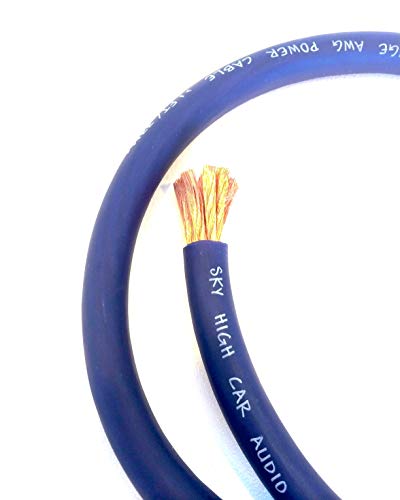
Sky High 1/0 OFC, 5 ft
$37.951/0-gauge power wire keeps drop low on longer, higher-current runs where a smaller gauge would lose too much voltage.
Check price on Amazon
DS18 AMPKIT4
$54.95A complete 4-gauge kit matches the gauge most 600 to 900 watt systems land on at a typical run length.
Check price on Amazon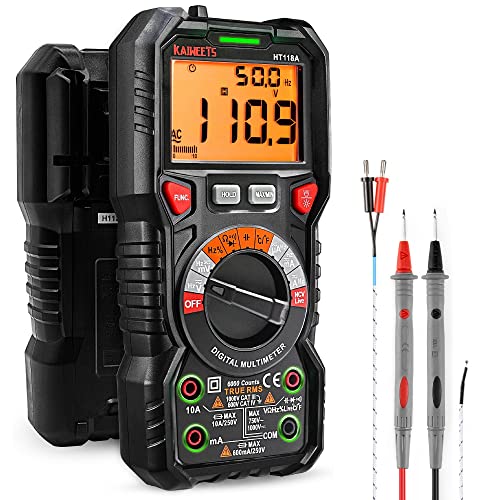
KAIWEETS automotive true RMS
$37.99A multimeter lets you measure actual voltage at the amplifier under load and compare it against these calculated figures.
Check price on Amazon
Sanuke 1/0 to 3/8 lugs, 10 pack
$7.99Properly sized lugs keep the connection itself from adding resistance on top of the wire's own calculated drop.
Check price on AmazonFrequently asked questions
- Why does the voltage drop formula multiply by 2?
- The 2 accounts for the full electrical circuit, not just the wire running to the amplifier. Current has to travel from the battery to the amplifier through the power wire, then return to the battery through the ground path, and both legs add resistance. Using only the one-way distance in the formula understates the real voltage drop by half, which is the single most common wiring math mistake in car audio.
- What voltage drop percentage is acceptable for an amplifier power wire?
- Most installers target 3 percent or less, with under 2 percent considered excellent and anything above 6 percent treated as a wiring problem. This is a planning convention rather than a published standard, but a drop in the 3 to 6 percent range is often audible as reduced headroom and clipping under heavy bass, which is reason enough to size up a gauge.
- Does a longer run really need a much heavier wire gauge?
- Yes, because voltage drop scales directly with distance at a fixed current and gauge. Doubling a run's length doubles its voltage drop, so a 25-foot trunk-mounted battery run needs meaningfully heavier wire than a 10-foot run to land at the same percentage drop, even though both runs might pass the same ampacity test with room to spare.
- Can 8-gauge wire handle 100 amps without a problem?
- It clears the ampacity table at 50 amps rated, so 100 amps already exceeds that limit before voltage drop even enters the picture. Even ignoring ampacity, 8-gauge at 100 amps over a 15-foot one-way run loses over 16 percent of system voltage, far past any usable target, which is why higher-current runs move to heavier gauge regardless of the ampacity number alone.
- How much voltage drop is normal on a short amplifier run?
- A short run, under about 10 feet one way, on a properly sized gauge typically lands under 2 percent drop, which most installers consider excellent. If a short run is showing several percent of drop, the wire is likely undersized for the amplifier's actual current draw rather than the length being the problem.
- Does voltage drop affect sound quality?
- Yes, indirectly. A significant voltage drop starves the amplifier of the voltage it needs to reach its rated output, which shows up as reduced headroom, earlier clipping under heavy bass, and in severe cases a protection shutdown under hard playing. Keeping drop under about 3 percent generally keeps the amplifier operating close to its rated performance.
Researched guidance, not professional advice. Actual voltage drop depends on your exact wire, run length, connectors, and current draw, and this chart uses NEC-published resistance figures rather than a specific product's measured performance. Verify against your own system's numbers before finalizing a wiring plan.