Head units
Should You Keep or Replace the Factory Head Unit?
Researched from published physics, alignment relations and manufacturer specifications. Updated .
Quick answer
The head unit decision gets framed as old versus new, but the real tradeoff is integration versus signal quality. A factory unit keeps steering wheel controls, chimes, backup camera displays, and any built-in vehicle settings working exactly as designed. An aftermarket unit trades some or all of that for cleaner preout voltage and crossover control that a factory unit rarely offers.
This guide breaks down what each path actually costs and gains, including the two things people miss most often: the remote turn-on signal an amplifier needs, and the factory bass rolloff that makes an amplified factory system sound thin at higher volumes.
What do you lose by replacing the factory head unit?
Steering wheel audio controls are the most commonly lost feature, though many aftermarket units support them through a steering wheel control interface adapter, which adds cost and installation complexity. Factory chimes, seatbelt and door alerts routed through the stereo, and any factory display integration, like a trip computer or vehicle settings menu shown on the head unit screen, are harder or impossible to fully replicate with an aftermarket unit.
Backup cameras are usually salvageable with the right aftermarket unit and adapter, but it is not guaranteed on every vehicle, and some factory systems route camera video through a proprietary format that needs a dedicated interface box to convert. Checking vehicle-specific compatibility before buying an aftermarket unit avoids a mismatch discovered after the dash is already apart.
Climate control is another area worth checking closely on newer vehicles, since some manufacturers have moved temperature and fan settings onto the factory touchscreen itself rather than leaving them on physical buttons. Replacing that screen with an aftermarket head unit on one of these vehicles can mean losing climate control entirely unless a specific retention harness or adapter exists for that model, which is a far bigger loss than losing steering wheel audio buttons and is easy to overlook when the excitement is focused on the new head unit's features.
What is the factory bass rolloff, and why does it matter?
Many factory head units reduce low-frequency output as volume rises, a deliberate design choice to protect small factory speakers from overexcursion. This is why a subwoofer amplified off a factory head unit's preout, or through a line output converter tapped from the speaker wires, can sound thin at higher volumes even with a properly sized amplifier and subwoofer behind it. The head unit itself is quietly limiting the low end before it ever reaches the amplifier.
Preout voltage: factory versus aftermarket
| Head unit type | Typical preout voltage | Practical effect |
|---|---|---|
| Factory head unit | ~1 to 2 volts (or none; speaker-level only) | Often needs a line output converter; more prone to noise on long RCA runs |
| Standard aftermarket | ~2 to 4 volts | Cleaner signal, more headroom before amplifier gain introduces noise |
| High-voltage aftermarket | ~4 to 5+ volts | Best signal-to-noise ratio on long cable runs or multi-amplifier systems |
Convention Source: Typical manufacturer specifications; individual models vary. Higher preout voltage means the amplifier's gain can be set lower for the same output level, which generally improves the system's overall signal-to-noise ratio.
What is the remote turn-on signal, and why does it get missed?
Every amplifier needs a 12-volt remote turn-on signal that switches on with the ignition to tell it when to power up, and this is separate from the audio signal itself. Aftermarket head units include a dedicated remote wire by default. Factory head units often do not provide an accessible one, which means it has to be sourced from a line output converter with a built-in turn-on trigger, a factory accessory wire, or in some cases a dedicated remote turn-on adapter.
Skipping this step and wiring an amplifier's remote lead to a random accessory wire can cause the amplifier to stay on with the key out, slowly draining the battery, or to turn on and off unpredictably if the wrong circuit is used. This is one of the most common surprises in a factory-head-unit build specifically because it has no equivalent problem on an aftermarket unit.
What do you gain by keeping the factory head unit?
Full retention of every factory feature is the obvious gain, but there is also a cost and time savings: no dash kit, no wiring harness adapter, and no risk of losing camera or climate control integration that some vehicles route through the factory display. For a build focused purely on adding an amplifier and subwoofer without touching the front stage's sound quality much, a factory head unit paired with a good line output converter is often the simpler and cheaper path.
The line output converter itself matters here. A basic one with fixed sensitivity can introduce noise or clip early if it is not matched to the factory system's actual output level, while a better unit with adjustable input sensitivity and a clean turn-on trigger avoids both problems.
Resale value is a secondary consideration some builders overlook. A vehicle with its factory head unit intact is generally easier to sell or trade without needing to source and reinstall the original unit, since dealerships and private buyers alike tend to view a factory-correct dash more favorably than one with an aftermarket unit that a future owner may not want. Keeping the original unit in a box, even when it is removed for an aftermarket swap, preserves that option later.
What you need for either path
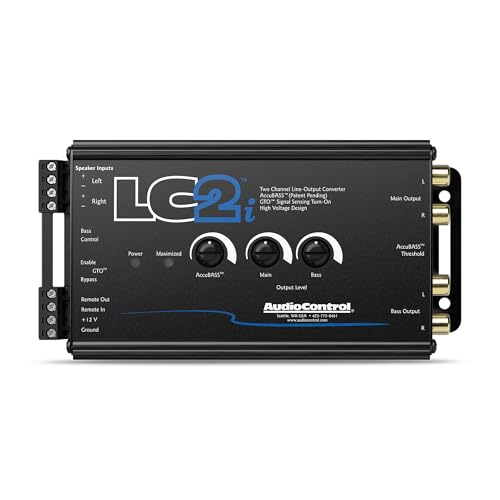
AudioControl LC2i with AccuBASS
$97.00A high-quality line output converter with adjustable sensitivity is the key piece for keeping a factory head unit and feeding an amplifier cleanly.
Check price on Amazon
Pioneer DMH-1600NEX
$300.00A double-DIN aftermarket unit with real preout voltage and crossovers for builds prioritizing signal quality over factory integration.
Check price on Amazon
Kenwood KMM-BT332U
$149.00A single-DIN aftermarket option for vehicles with a smaller dash opening that still want proper preouts.
Check price on AmazonCommon mistakes in this decision
The most common mistake is replacing the head unit for sound quality without checking whether the vehicle's backup camera and steering wheel controls can be retained, which turns a straightforward upgrade into an unexpected adapter shopping trip. The reverse mistake is keeping the factory unit and skipping a proper line output converter, tapping speaker wires directly into an amplifier's RCA-only input in a way that introduces noise or an unreliable turn-on trigger.
A third mistake is not accounting for the factory bass rolloff at all, then troubleshooting a subwoofer that sounds weak at higher volumes by chasing amplifier gain or wiring when the head unit itself is the actual limiting factor. Testing the factory preout or LOC output at the volume level the system will actually be used at, not just at a quiet baseline, catches this before it gets blamed on the wrong component.
A fourth, easy-to-miss mistake is buying an aftermarket head unit before confirming it physically fits the dash opening and vehicle-specific wiring harness. Single-DIN and double-DIN openings are not universal across trims of the same model year, and a unit that looks correct on a listing page can still need a different harness adapter or trim kit than expected, which is worth confirming against the vehicle's exact year, make, and trim before ordering rather than after the dash is already open.
Frequently asked questions
- Do I need a line output converter if I keep my factory head unit?
- Yes, in almost every case. Most factory head units either have no RCA preouts at all or preouts too weak and noisy for a proper amplifier connection. A line output converter taps the factory speaker wires and converts that signal to a clean RCA-level output an amplifier can use, and a good one also includes a remote turn-on trigger the factory system otherwise lacks.
- Why does my subwoofer sound weak even though the amplifier is properly sized?
- The factory head unit may be applying a built-in bass rolloff that reduces low-frequency output as volume increases, a common design choice meant to protect small factory speakers. This limits what reaches the amplifier before gain or wiring ever comes into play, and it is one of the most overlooked causes of a thin-sounding subwoofer on a factory-fed system.
- What is remote turn-on and why does my amplifier need it?
- Remote turn-on is a 12-volt signal, separate from the audio itself, that tells an amplifier to power on with the ignition and off with it. Aftermarket head units include this wire by default, while factory head units usually do not, which means it has to come from a line output converter's turn-on trigger or another dedicated source.
- Will I lose my backup camera if I replace the factory head unit?
- It depends on the vehicle. Many aftermarket units can accept a backup camera input directly or through an adapter, but some factory systems route camera video through a proprietary format that needs a dedicated interface box to convert. Checking vehicle-specific compatibility before buying avoids losing the camera after the install is already underway.
- Is aftermarket preout voltage really better than factory?
- Usually, yes. Factory preouts, where they exist at all, typically run around 1 to 2 volts, while aftermarket units commonly offer 2 to 5 volts or higher. Higher voltage lets the amplifier's gain sit lower for the same output level, which generally improves the overall signal-to-noise ratio, especially on longer RCA runs.
- Can I keep steering wheel controls with an aftermarket head unit?
- Often yes, through a steering wheel control interface adapter matched to the vehicle, though it adds cost and sometimes a small amount of button lag compared to factory response. Not every vehicle has a reliable adapter available, so checking compatibility for the specific make and model before buying the head unit avoids losing that functionality.
Researched guidance, not professional advice. Factory integration options vary widely by vehicle make, model, and trim, and camera or steering wheel control compatibility should be confirmed for the specific vehicle before any dash work begins. When integration options are unclear, check with someone experienced in that vehicle's factory wiring before removing the factory unit.