Enclosures
What Size Sealed Box for 4 15 Inch Subwoofers?
Researched from published physics, alignment relations and manufacturer specifications. Updated .
Quick answer
This page answers one question: how much air do 4 15 inch subwoofers need behind them in a sealed box? The short version is 7 to 12 cubic feet net, in total, across all 4 drivers.
The longer version matters more. Two 15 inch drivers from different manufacturers can want enclosure volumes that differ by a factor of two, because the number that sets enclosure volume is the driver's compliance, not its diameter. Run your own driver's published parameters through the sealed box volume calculator and use that figure, and use the range on this page only to sanity check it or to plan a space before you have chosen a driver.
How many cubic feet for 4 15 inch subs?
Net internal volume is the air the driver actually sees, after the driver itself, the port and any bracing have taken their share. These are typical published ranges by nominal size.
| Drivers | Sealed, net | Ported, net | Typical ported tuning |
|---|---|---|---|
| 1 driver | 1.75 to 3 cu ft | 3 to 5 cu ft | 28 to 33 Hz |
| 2 drivers | 3.5 to 6 cu ft | 6 to 10 cu ft | 28 to 33 Hz |
| 3 drivers | 5.25 to 9 cu ft | 9 to 15 cu ft | 28 to 33 Hz |
| 4 drivers | 7 to 12 cu ft | 12 to 20 cu ft | 28 to 33 Hz |
Convention Source: Typical ranges compiled across published manufacturer enclosure recommendations for this nominal size. These are planning ranges, not specifications. Drivers of the same nominal size routinely differ by a factor of two, and the manufacturer figure for your exact model is the one to build to.
Where the sealed number actually comes from
Sealed volume is set by the driver's compliance and its total Q, not by its diameter. The relation is Vb = Vas / ((Qtc / Qts)^2 - 1), where Vas is the equivalent compliance volume, Qts is the driver's total Q, and Qtc is the system Q you are aiming for. A Qtc of 0.707 is maximally flat, and lower values need a bigger box.
Worked through with a representative 15 inch driver, Vas 2.6 cubic feet, Qts 0.4 and Fs 29 Hz, a Qtc of 0.707 asks for 1.224 cubic feet per driver with a system resonance of 51.3 Hz. Those parameters are an example rather than any particular product's specification.
Note what the equation does when you lower the target Qtc: the box gets larger, quickly. Below a Qtc equal to the driver's own Qts there is no solution at all, because a box can only raise the total Q and never lower it.
Gross volume, net volume, and the difference that catches people out
Every manufacturer enclosure recommendation is a net figure. Net volume is the gross internal volume of the box less the driver displacement, less the port displacement on a vented box, and less any bracing. On a 12 cubic foot sealed build, the drivers alone can take 0.32 to 0.72 cubic feet.
Driver displacement is a published number on the specification sheet and it cannot be worked out from the nominal size. If you do not have it, you cannot compute net volume, and the net volume calculator will tell you so rather than substituting a guess. Work out the gross internal volume of your panel dimensions with the box dimensions calculator first.
Prebuilt boxes for 4 15 inch subs
A prebuilt box is a reasonable choice, with one condition: it has to state its internal volume. Many listings do not, and the internal volume is the single most important number about an enclosure. Where a box states its volume, check that figure against what your driver's manufacturer publishes before buying either one.

Goldwood TR12S sealed 12
$48.99The cheapest sealed 12 here, and sealed is the alignment that forgives a volume error.
Check price on Amazon
QPower HD112 sealed 12
$49.99A heavy duty single 12 sealed box built for a driver that is going to get used hard.
Check price on Amazon
Rockville RMS12, 1.6 cu ft
$54.95A stated 1.6 cubic feet in 3/4 inch MDF, which is at the large end of sealed for a 12 and suits a low Qts driver.
Check price on Amazon15 inch subwoofers with published specifications

Skar Audio SDR-15 D2
Price varies, check the listingThe cheapest way into 15 inches of cone area from a brand that publishes parameters.
Check price on Amazon Skar Audio SDR-15 D4
Price varies, check the listingThe dual 4 ohm version of the same driver, for a two driver build on one amplifier.
Check price on Amazon
Rockville W15K9D2
$159.95One of the few drivers in this catalog with a CEA rated RMS figure rather than only a peak number.
Check price on Amazon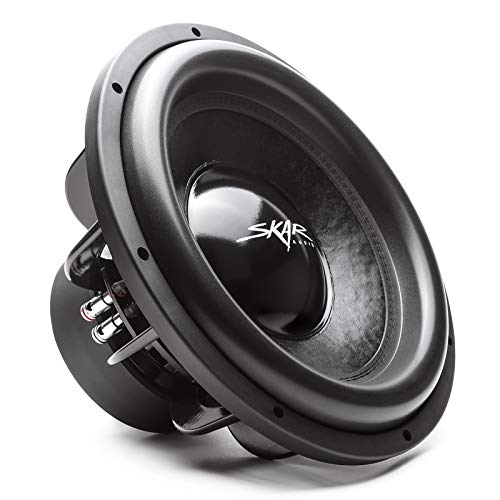
Skar Audio EVL-15 D4
Price varies, check the listingHigh excursion in the largest common size, which means a big box and a charging system to match.
Check price on AmazonFrequently asked questions
- How many cubic feet does 4 15 inch subwoofers need?
- In a sealed enclosure, 4 15 inch drivers typically need 7 to 12 cubic feet of net internal volume in total. That is a planning range rather than a specification. The real figure comes from the driver's own Vas and Qts, and two drivers of this nominal size can genuinely want volumes that differ by a factor of two, so always check the manufacturer recommendation for your exact model.
- Is a bigger box always better for a subwoofer?
- No. In a sealed box, a larger volume lowers the system Q, which gives a flatter response and lower extension but less output near resonance and more excursion for the same power. In a ported box, too much volume with the same tuning changes the alignment away from what the driver suits and can leave a peak followed by a steep rolloff. Bigger is a trade, not an upgrade.
- What happens if the box is too small?
- A sealed box that is too small raises the total system Q, which produces a peak near resonance and a leaner, boomier sound that rolls off early. It also stiffens the air spring, which limits excursion at low frequencies but concentrates output in a narrow band. A ported box that is too small for its tuning ends up with a port so long it will not fit, which is usually the first sign something is wrong.
- Does the number of drivers change the volume per driver?
- No. Each driver needs its own share of net volume, so 4 drivers need 4 times the single-driver figure. Whether they share one chamber or get separate chambers is a different question: separate chambers protect you if one driver fails, while a shared chamber is simpler to build and is what most prebuilt multi-driver boxes use.
- Should I choose sealed or ported for 15 inch drivers?
- Sealed is smaller, flatter, far more forgiving of a volume error and better suited to music with a lot of low frequency detail. Ported is louder for the same power over a narrower band and needs a bigger box plus a port that physically fits. If this is a first build, sealed is the safer choice precisely because getting the volume slightly wrong matters much less.
Build it to the driver, not to a rule of thumb. The only enclosure volume that governs is the one the driver manufacturer publishes for that exact model. A box that is meaningfully too small raises the system Q and can drive a subwoofer past its excursion limit at frequencies it should handle easily, and a ported box that is too large or tuned too low unloads the cone below tuning. If your driver does not publish a recommended volume, use its Thiele/Small parameters in the calculators rather than a figure taken from a driver of the same nominal size.