Reference
Subwoofer Wiring Impedance Chart: Every Series and Parallel Load
Researched from published physics, alignment relations and manufacturer specifications. Updated .
Quick answer
The number printed on a subwoofer box, like "dual 4 ohm" or "D2," describes one voice coil, not the load the amplifier actually sees. A dual voice coil (DVC) driver has two coils wound around the same former, and how those two coils are wired together, in series or in parallel, sets the final impedance before you even get to combining multiple drivers. A single voice coil (SVC) driver skips that step entirely: it has one coil, so it presents its rated ohm figure directly, and the only wiring decision left is how to combine it with other drivers.
This chart works out every practical combination for one to four drivers at the four coil types car audio actually sells: SVC 2 ohm, SVC 4 ohm, DVC 2 ohm (D2), and DVC 4 ohm (D4). Every value comes straight from Ohm's law series and parallel rules, not a manufacturer's marketing chart, so it holds for any brand. Cross-check the final number against your amplifier's rated stable load before wiring anything, and use the subwoofer wiring calculator to double-check a specific combination against this table.
What ohm load does one subwoofer actually present?
Before combining multiple drivers, start with a single one. An SVC driver has no series-or-parallel choice at all: whatever is printed on the coil is the load. A DVC driver has exactly two options, since it only has two coils to work with.
| Voice coil type | Coils in series | Coils in parallel | Note |
|---|---|---|---|
| SVC 2 ohm | n/a, one coil | n/a, one coil | Presents 2 ohms to the amp regardless of how it is wired |
| SVC 4 ohm | n/a, one coil | n/a, one coil | Presents 4 ohms to the amp regardless of how it is wired |
| DVC 2 ohm (D2) | 4 ohms | 1 ohm | Never presents 2 ohms when both coils are used |
| DVC 4 ohm (D4) | 8 ohms | 2 ohms | Never presents 4 ohms when both coils are used |
Published figure Source: Ohm's law: R(series) = R1 + R2; 1/R(parallel) = 1/R1 + 1/R2. A D4 coil pair is named for one coil, not the final load. Series and parallel are the only two wiring options a single DVC driver has.
Full impedance matrix: one to four subwoofers, D2 and D4
Once you add a second, third, or fourth driver, the number of wiring paths grows fast, because each driver's own coils can be wired series or parallel before the drivers themselves are combined series or parallel with each other. The table below lists every distinct final load for one, two, three, and four D2 or D4 subwoofers.
| Drivers | Wiring method | D2 final load | D4 final load |
|---|---|---|---|
| 1 | Coils in series | 4 ohms | 8 ohms |
| 1 | Coils in parallel | 1 ohm | 2 ohms |
| 2 | Coils series, subs in parallel | 2 ohms | 4 ohms |
| 2 | Coils parallel, subs in series | 2 ohms | 4 ohms |
| 2 | All four coils in parallel | 0.5 ohm | 1 ohm |
| 2 | All four coils in series | 8 ohms | 16 ohms |
| 3 | Coils series, subs in parallel | 1.33 ohms | 2.67 ohms |
| 3 | Coils parallel, subs in series | 3 ohms | 6 ohms |
| 3 | All six coils in parallel | 0.33 ohm | 0.67 ohm |
| 3 | All six coils in series | 12 ohms | 24 ohms |
| 4 | Coils series, subs in parallel | 1 ohm | 2 ohms |
| 4 | Coils parallel, subs in series | 4 ohms | 8 ohms |
| 4 | All eight coils in parallel | 0.25 ohm | 0.5 ohm |
| 4 | All eight coils in series | 16 ohms | 32 ohms |
Published figure Source: Ohm's law series and parallel combination rules. Three-driver values are rounded from repeating decimals (4/3 ohms, 2/3 ohm, and so on). Amplifier stability, not preference, should decide which row you actually wire to.
SVC subwoofers: combining drivers without a coil choice
Single voice coil drivers skip the per-driver decision entirely. The only variable left is whether the drivers themselves are wired to each other in series or in parallel, which makes SVC math simpler but also gives you fewer final-load options to work with.
| Drivers | Wiring | SVC 2 ohm final | SVC 4 ohm final |
|---|---|---|---|
| 1 | Single driver | 2 ohms | 4 ohms |
| 2 | Series | 4 ohms | 8 ohms |
| 2 | Parallel | 1 ohm | 2 ohms |
| 3 | Series | 6 ohms | 12 ohms |
| 3 | Parallel | 0.67 ohm | 1.33 ohms |
| 4 | Series | 8 ohms | 16 ohms |
| 4 | Parallel | 0.5 ohm | 1 ohm |
Published figure Source: Ohm's law series and parallel combination rules. SVC drivers only offer the between-driver choice: series raises the final load, parallel lowers it, with nothing in between.
Reading the chart against your amplifier
The chart answers "what load results from this wiring," but the useful question is usually the reverse: "what wiring gets me to a load my amp can handle." Most mono subwoofer amps are rated stable down to 2 ohms or 1 ohm, and a growing number of budget and mid-tier amps claim stability to 0.5 ohm, but that number always comes from the amplifier's own spec sheet, never from a rule of thumb. A single D4 driver wired in parallel already reaches 2 ohms, which is why a lone D4 sub is such a common pairing with an entry-level mono amp. Two D2 subs, each with coils wired in parallel and the two subs wired in series, also lands at 2 ohms, which is a second path to the same target load using different hardware.
When a build calls for a lower final load than a single driver's parallel wiring provides, the usual move is to add a second driver and put the two drivers in parallel with each other, which halves whatever load a single driver alone produces. That is how builders reach 1 ohm with two D2 subs, or 0.5 ohm with four D2 subs, both shown in the tables above. The tradeoff is current draw: a lower final load pulls more current from the amplifier at any given power level, which is exactly why the amplifier's rated minimum load exists as a hard limit rather than a suggestion.
Wiring below the amp's rated minimum load
Presenting an amplifier with a load lower than its rated minimum is one of the most common ways amplifiers die. A 2 ohm stable amp wired down to 1 ohm draws roughly double the current it was designed for at any given voltage, which shows up as excess heat in the output devices, thermal shutdown under load, or in the worst case a blown amplifier that never turns back on. Always confirm the final load from this chart against the amplifier's own stable-load spec sheet before you connect a single wire, not after.
Gear for this

AstroAI true RMS multimeter
$34.99A basic digital multimeter confirms the actual resistance of each coil and the final wired load before power ever reaches the amp, catching a wiring mistake before it becomes a dead amplifier.
Check price on Amazon
DS18 16 gauge ultra flex, 100 ft
$14.95Properly sized speaker wire between the amp and each driver matters more at lower final loads, where current is higher and voltage drop across thin wire becomes a real loss.
Check price on Amazon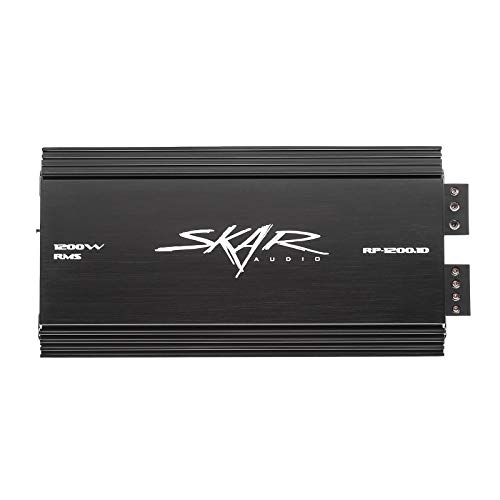
Skar Audio RP-1200.1D
Price varies, check the listingA mono amp rated stable to 1 ohm gives builders running two D2 subs in parallel, or four D4 subs down to 1 ohm, real headroom instead of running right at the edge of the amp's spec sheet.
Check price on AmazonFrequently asked questions
- Why does a D4 subwoofer never wire to 4 ohms?
- A D4 subwoofer has two separate 4 ohm coils, and the only two ways to combine two equal resistors are series, which adds them for 8 ohms, and parallel, which halves them for 2 ohms. There is no wiring path that produces 4 ohms from two 4 ohm coils on a single driver, which is why the name refers to one coil, not the final load.
- What happens if I wire below my amplifier's rated minimum load?
- The amp draws significantly more current at any given voltage than it was designed for, which generates excess heat in the output transistors. Depending on the amp's protection circuitry, it may go into thermal shutdown repeatedly during use, or it can fail outright and not recover. Always check the amp's stable-load spec before wiring to the lowest option on this chart.
- Do two SVC 4 ohm subs in parallel equal one D4 sub in parallel?
- Yes, both land at 2 ohms, since two SVC 4 ohm drivers in parallel behave identically to a single D4 driver with its two coils wired in parallel. The difference is cost and flexibility: two separate SVC subs cost more and take more space, while one D4 driver reaches the same 2 ohm load from a single enclosure cutout.
- Is series or parallel wiring louder?
- Neither wiring method changes how loud a given driver is at a given power level; impedance affects how much power the amp can deliver, not the driver's efficiency. A lower final load generally lets a given amp put out more watts, which is why parallel wiring, which lowers impedance, is often associated with more output, but the loudness gain comes from the extra watts, not the wiring itself.
- Can I mix a D2 and a D4 subwoofer on the same amp channel?
- You can wire them together electrically, but the math gets messy because the two coil types do not share a common per-driver load, and the resulting final impedance often lands somewhere an amp is not rated for. It is far simpler and more predictable to match identical drivers on a shared channel and keep mismatched drivers on separate amp channels.
- How do I check my actual wired impedance instead of assuming it?
- Disconnect the amp, then measure resistance directly across the speaker wire leads with a digital multimeter set to the ohms function. The reading will run slightly below the nominal figures in this chart because of voice coil resistance versus rated impedance, which is normal, but a reading wildly off the expected value usually means a wiring mistake.
Researched guidance, not professional advice. Confirm the final wired load against your amplifier's own rated minimum before connecting anything, since presenting a load below that rating is how amplifiers overheat and fail. Disconnect the battery before working on power wiring, and verify the actual wired resistance with a multimeter rather than assuming the chart's nominal figures exactly.