Power
How Loud Is 250 Watts on a 12 Inch Subwoofer?
Researched from published physics, alignment relations and manufacturer specifications. Updated .
Quick answer
Sound pressure from power is a logarithmic relation and it is the reason bigger amplifier numbers disappoint people. SPL = sensitivity + 10 x log10(watts). Doubling the power is always 3 dB, no matter where you start, and roughly 10 dB is needed before most listeners describe something as twice as loud. Ten decibels is ten times the power.
So 250 watts into a 85 dB 12 inch driver gives about 109 dB anechoic. Then a car does something a room does not: below the frequency where the cabin behaves as a pressure vessel, it reinforces low frequency substantially. That cabin gain is a convention rather than a measurement and it varies enormously by vehicle. Try your own numbers in the SPL calculator.
What 250 watts actually buys you
The same driver at every common power level, so you can see what the next amplifier up is worth.
| Power | Anechoic at 1 m | With 6 dB cabin gain | Gain over 250 W |
|---|---|---|---|
| 250 W | 109 dB | 115 dB | 0 dB |
| 500 W | 112 dB | 118 dB | 3 dB |
| 750 W | 113.8 dB | 119.8 dB | 4.8 dB |
| 1,000 W | 115 dB | 121 dB | 6 dB |
| 1,500 W | 116.8 dB | 122.8 dB | 7.8 dB |
| 2,000 W | 118 dB | 124 dB | 9 dB |
Published figure Source: SPL = sensitivity + 10 x log10(power), the logarithmic power relation. Note the last column. Going from 250 to 2,000 watts, an eight fold increase in power and usually in price, is 9 dB. That is real and it is much less than the numbers suggest.
Adding drivers against adding power
Two identical drivers sharing the same signal gain 3 dB from the extra cone area alone, before any extra power. That makes driver count a better lever than amplifier power in most builds.
| Drivers | Total power | Anechoic at 1 m | With cabin gain |
|---|---|---|---|
| 1 | 250 W | 109 dB | 115 dB |
| 2 | 500 W | 112 dB | 118 dB |
| 3 | 750 W | 113.8 dB | 119.8 dB |
| 4 | 1,000 W | 115 dB | 121 dB |
Published figure Source: SPL = sensitivity + 10 x log10(power), the logarithmic power relation. This assumes identical drivers in identical enclosures sharing the same signal, which is the only case where the arithmetic is this clean. Mixed drivers in a shared box do not add this way.
Why sensitivity beats power on a budget
A driver with 3 dB more sensitivity is exactly as loud as the same driver on twice the power. Three decibels of sensitivity is often free in the choice between two drivers at the same price, whereas doubling amplifier power costs an amplifier, heavier wire, a bigger fuse and possibly an alternator.
This matters most in the door speakers rather than the subwoofer, because a door speaker frequently runs off head unit power where every watt is precious. It matters less in a subwoofer, where the drivers cluster within a few dB of each other and excursion is the real limit.
What this number is not
This is an estimate, not a competition score. A metered burp on a calibrated meter placed at the windscreen measures peak pressure at one point inside a sealed vehicle, and it routinely reads far higher than any free space calculation. It is measuring something genuinely different. Use the numbers here to compare one build option against another, not to predict what a meter will say.
Hearing, honestly
Sustained exposure above roughly 100 dB causes measurable and permanent hearing loss within minutes, and above 120 dB the damage is much faster. Low frequency content feels less loud than it measures, which is precisely what makes a subwoofer dangerous: the perceived loudness does not warn you.
If you want to know what your system actually does, a 30 to 130 dB A and C weighted meter costs about the same as a set of door speakers. C weighting is the one to use for bass, because A weighting deliberately discounts low frequencies.

Tresalto trim removal set, 5 piece
$7.95Nylon pry tools at under eight dollars, which is cheaper than one broken door card clip.
Check price on Amazon
AstroAI true RMS multimeter
$34.99True RMS at under thirty five dollars, which is the cheapest meter that will read a test tone correctly for gain setting.
Check price on Amazon12 inch subwoofers for this power level

CT Sounds Tropo 12 D4
$129.99A dual 4 ohm 12 that wires to 8 or 2 ohms with one driver, which keeps the amplifier choice open.
Check price on Amazon
Orion Cobalt CBW124D
$74.95The cheapest dual 4 ohm 12 in this catalog from a brand that has published specifications.
Check price on Amazon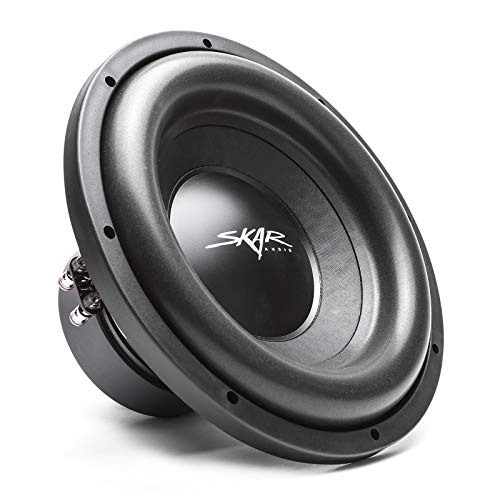
Skar Audio SDR-12 D4
Price varies, check the listingA 2.5 inch four layer coil and a published 22 Hz to 300 Hz response, which is the usual first real subwoofer.
Check price on Amazon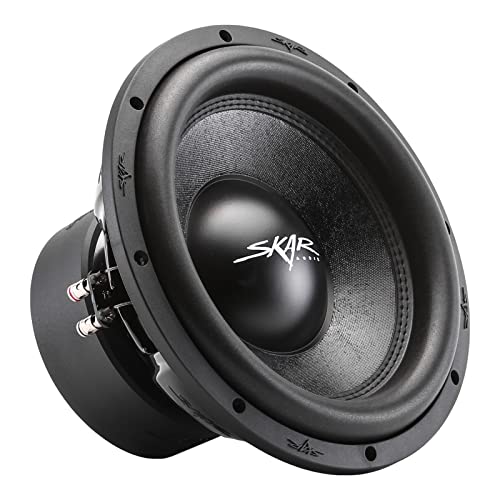
Skar Audio SVR-12 D4
Price varies, check the listingA step up in motor and excursion from the SDR at the same coil configuration, so an existing box often still suits it.
Check price on AmazonFrequently asked questions
- How loud is 250 watts on a 12 inch subwoofer?
- About 109 dB at one metre in free space for a driver with 85 dB sensitivity, or roughly 115 dB allowing a conservative 6 dB of cabin gain. Cabin gain in a real vehicle ranges from about 6 to 12 dB and depends heavily on how well the car is sealed, so treat the cabin figure as a range rather than a prediction.
- How much louder is double the power?
- Exactly 3 dB, always, regardless of where you start. That is a noticeable change but a modest one, and it is why the jump from a 500 watt amplifier to a 1,000 watt amplifier disappoints people who expected something dramatic. To sound roughly twice as loud you need around 10 dB, which is ten times the power.
- Is a bigger subwoofer louder than more power?
- Usually, yes, and more cheaply. Two identical drivers gain 3 dB from cone area alone before any extra power, and moving from a 12 to a 15 inch driver typically buys a couple of decibels of sensitivity for free. Cone area is the cheapest decibel in car audio, and the constraint is almost always space rather than money.
- What is cabin gain?
- Below the frequency where the wavelength is long compared with the vehicle interior, the cabin stops behaving like a room and starts behaving like a sealed pressure vessel. Moving the cone pressurises the whole space rather than launching a wave, which reinforces low frequency output substantially. Figures between 6 and 12 dB are quoted, it varies enormously by vehicle, and it is not a published specification.
- At what point does a car audio system damage hearing?
- Sustained exposure above roughly 100 dB causes measurable permanent hearing loss within minutes, and the damage accumulates and does not heal. Bass is particularly deceptive because low frequencies feel less loud than they measure. Competition operators use hearing protection and leave the vehicle during a run, which is a reasonable indicator of what those levels really are.
Hearing damage is permanent. Sustained exposure above roughly 100 dB causes measurable hearing loss within minutes, and the damage does not heal. A system capable of the numbers on this page is not one to sit inside at full output, and the fact that low frequencies feel less loud than they measure is exactly what makes them dangerous. Competition operators wear hearing protection and leave the vehicle for a reason.