Install
How to Sound Deaden a Car Door the Right Way
Researched from published physics, alignment relations and manufacturer specifications. Updated .
Quick answer
Sound deadening a car door is often sold as one product applied once, but a door actually has at least two separate noise and performance problems, and one material does not solve both. The outer door skin, the sheet metal between the speaker and the outside of the car, can ring like a drum when the speaker moves it, which colors the sound and wastes energy that should be moving air. The inner trim panel, meanwhile, can buzz, rattle, and let road and wind noise through, which is a different problem with a different fix. On top of both of those, a speaker mounted with an open back needs the door itself sealed to behave like an enclosure, or its front and rear wave cancel each other out.
This guide separates those three jobs, gives the coverage amount that applies to each, and explains why skipping the inner skin seal specifically undermines everything else.
What actually needs deadening in a door, and why?
A door has an outer sheet metal skin, an inner sheet metal skin with a speaker mounting point, and an inner trim panel that faces the cabin. The outer skin flexes and rings under the pressure the speaker creates, since bare sheet metal has very little damping on its own. The trim panel is a separate, usually plastic, part that can buzz against its clips and pick up road noise transmitted through the door structure. And the gap between the inner skin and the outer skin is, whether anyone planned it that way or not, an air space that the back of the speaker cone is firing into, which means it behaves acoustically like a badly sealed, leaky enclosure unless it is treated as one on purpose.
Two different layers for two different jobs
| Layer | Problem it solves | Coverage |
|---|---|---|
| Butyl constrained layer damper | Outer skin ringing and panel resonance | Around 25 percent, by convention |
| Closed cell foam | Trim panel decoupling, rattles, road noise | Full coverage |
| Sealant on inner skin seams | Turns the door into a sealed enclosure for the speaker | All seams and gaps |
Convention Source: 25 percent coverage guideline is a widely used convention, not a measured universal threshold.
The 25 percent coverage guideline
Roughly 25 percent coverage is a convention, not a measured law. Butyl constrained layer dampers work by adding mass and internal damping to a resonant panel, and in practice most of the audible improvement in ringing shows up once a moderate portion of the panel is covered, commonly cited as around a quarter of the surface. Covering the entire outer skin in butyl adds weight and cost without a proportional improvement, which is why butyl is typically applied more sparingly than the closed cell foam layer that follows it.
Stay off the mechanism, keep the drain holes clear
Keep material off the window regulator and away from drain holes. A door has drain holes at the bottom of the outer skin specifically so water that gets past the window seal can escape, and blocking them with deadening material traps moisture inside the door where it can cause rust and electrical problems over time. The window regulator mechanism, tracks, and motor also need to move freely, so material should be planned around them, not over them, and reinstalled panels should be checked to confirm the window still moves smoothly before the door is closed up.
Step by step: deadening a door for a speaker
- Remove the door panel and vapor barrier, and clean the outer skin of any factory oils or residue.
- Apply butyl constrained layer damper to the outer skin at roughly 25 percent coverage, focusing on the largest flat areas most prone to ringing, and roll each piece down firmly for full contact.
- Seal every seam, wiring grommet, and gap on the inner door skin with butyl or a dedicated sealant so the cavity behind the speaker is as airtight as practical.
- Reinstall the vapor barrier, sealing its edges rather than leaving it loose.
- Apply closed cell foam at full coverage to the back of the trim panel and any areas prone to buzzing against the door structure.
- Reinstall the trim panel and confirm the window and any door-mounted controls still operate normally.
Why sealing the inner skin matters as much as the speaker itself
A speaker with an open back radiates sound from the front of the cone and the back of the cone at the same time, and those two waves are out of phase with each other. If nothing separates them, the rear wave can reach around and cancel part of the front wave, which shows up as reduced bass output and a thinner sound overall, no matter how good the speaker or how carefully the outer skin was treated. Sealing the inner door skin's seams, wiring holes, and speaker mounting gasket turns the door cavity into a rough enclosure for the speaker, keeping the rear wave contained instead of letting it cancel the front wave. This step is easy to skip because it is invisible once the door is closed up, but it has a direct, audible effect on how much bass the door speaker actually produces.
What you need

Kilmat 80 mil, 36 sq ft
$69.95An 80 mil butyl constrained layer damper with 36 square feet of coverage, enough for the outer skins of several doors at the 25 percent convention.
Check price on Amazon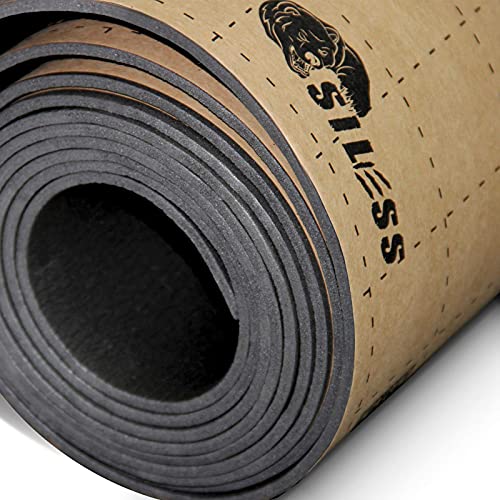
Siless Liner 4 mm, 36 sq ft
$44.95A 4mm closed cell foam liner for the trim panel side, addressing rattles and road noise separately from the butyl layer.
Check price on Amazon
80 mil butyl mat, 10 sq ft
$19.99A smaller 10 square foot butyl option sized for a single door or a small treatment area without buying a full roll.
Check price on Amazon
Poraxy 19 piece trim tool kit
$17.99A 19 piece trim removal tool set with clip pliers for removing door panels without breaking factory plastic clips.
Check price on AmazonFrequently asked questions
- Do I need to deaden the entire door, or just part of it?
- It depends on the layer. Butyl damper on the outer skin is applied at around 25 percent coverage by convention, since most of the ringing reduction happens well before full coverage. Closed cell foam on the trim panel side is applied at full coverage, since it is solving a different, decoupling problem rather than a resonance problem.
- What is the difference between butyl deadener and closed cell foam?
- Butyl is a constrained layer damper that adds mass and internal damping to stop the metal door skin from ringing under speaker pressure. Closed cell foam is a decoupling layer that goes between the trim panel and the door structure to stop buzzing, rattling, and reduce road noise transmission, which is a separate problem from panel resonance.
- Will deadening a door actually improve bass from a door speaker?
- Yes, mainly through sealing the inner door skin. A speaker with an unsealed door behind it loses output because the rear wave from the cone cancels part of the front wave. Sealing the seams and gaps on the inner skin turns the door into a rough enclosure, which reduces that cancellation and lets more of the speaker's output reach the cabin.
- Can sound deadening cause problems with the window regulator?
- It can if material is applied over the tracks, motor, or moving arm of the regulator. Deadening should be planned around the mechanism, not on top of it, and the window should be tested for smooth operation before the trim panel is fully reinstalled and the door is closed up for good.
- Why do drain holes in a door matter for deadening?
- Drain holes let water that gets past the window seal escape from the bottom of the door rather than pooling inside it. Covering them with deadening material traps moisture against bare metal, which can lead to rust and electrical corrosion over time, so they need to stay clear during any deadening install.
- Is closed cell foam still necessary if butyl is already installed?
- Yes, because they solve different problems. Butyl addresses the outer skin ringing under speaker pressure, while closed cell foam decouples the trim panel from the door structure and reduces rattles and road noise. Skipping the foam layer leaves the trim panel problem unaddressed even with a fully treated outer skin.
Researched guidance, not professional advice. Work carefully around factory wiring, airbags, and window mechanisms, and consult a professional installer if a door has side airbags or unfamiliar factory wiring routed through it.