Install
How to Install a Line Output Converter (LOC)
Researched from published physics, alignment relations and manufacturer specifications. Updated .
Quick answer
Adding an amplifier to a car with a factory, non-amplified head unit almost always means installing a line output converter. Factory head units output speaker-level signal built to drive speakers directly, not the low-voltage RCA line-level signal an aftermarket amplifier expects, and an LOC sits between the two, converting one into the other.
Two details separate a clean LOC install from a frustrating one: getting the remote turn-on signal right, since many factory harnesses have no dedicated wire for it, and understanding factory bass rolloff, which explains why a factory-fed amplified system can sound thin even when everything is wired correctly.
What problem does a line output converter actually solve?
A factory head unit's internal amplifier drives its speaker outputs at a relatively high voltage and current, meant to push speaker cone movement directly with no external amplifier in between. An aftermarket amplifier, by contrast, expects a low-voltage RCA line-level input, the same kind of signal an aftermarket head unit's dedicated preamp outputs would provide.
An LOC bridges that gap. It taps into the factory speaker wire outputs, safely reduces (or in some cases boosts) that signal down to line level, and hands it off through RCA cables to the amplifier's input. Without one, you either have to replace the entire factory head unit or find some other way to generate a proper line-level signal for the amp.
Active or passive: which type of LOC do you need?
An active LOC with a line driver raises the signal voltage, while a passive LOC only divides the existing signal down. Active converters generally produce a cleaner, stronger signal with less noise, especially in cars where the factory speaker output is weaker to begin with, and most current LOC models on the market are active for this reason.
How does the remote turn-on wire work with an LOC?
An aftermarket amplifier needs a 12-volt remote turn-on signal to switch on when the stereo is playing, and factory harnesses in most modern vehicles do not include a dedicated wire for this the way an aftermarket head unit would. This is where a signal-sensing LOC earns its keep: many LOC models include a built-in circuit that detects when the factory speaker output starts carrying an audio signal and generates its own 12-volt remote turn-on output in response.
That signal-sensing output gets wired directly to the amplifier's remote turn-on terminal, just as if it came from a dedicated aftermarket head unit wire. Confirm before buying whether the specific LOC model includes this feature, since some basic LOCs handle only the audio conversion and leave the remote turn-on problem for you to solve another way.
Why does a factory amplified system sound thin at higher volume?
Many factory head units apply bass rolloff as volume increases, reducing low frequency output to protect small factory speakers from overload. This is a normal, intentional factory design choice, but it means an aftermarket amplifier fed straight from a basic LOC inherits that same rolloff, which is why the system can sound thin at higher volumes even with a much larger amplifier attached.
What LOC features solve the bass rolloff problem?
| LOC type | Remote turn-on output | Best for |
|---|---|---|
| Basic 2-channel LOC | No, needs a separate trigger source | Simple single-amp installs where another remote source is available |
| Signal-sensing LOC | Yes, senses the speaker signal to trigger the amp | Factory head units with no dedicated remote wire |
| Bass-restoration LOC | Yes | Systems where factory volume-based bass rolloff is thinning out the low end |
Convention Source: Manufacturer feature specifications. A bass-restoration LOC counteracts the factory rolloff at the conversion stage, which is a more direct fix than trying to compensate for it later with EQ or gain alone.
What you need

Scosche LOC80
$9.99A dependable 2-channel LOC covers a basic single-amplifier install where a remote turn-on source is already available elsewhere.
Check price on Amazon
Kicker 46KISLOC2
$19.99A signal-sensing LOC generates its own remote turn-on output, solving the missing-remote-wire problem common to factory head units.
Check price on Amazon
CT Sounds CT-LC2 with BassLift
$49.99A LOC built with bass-lift circuitry helps counteract factory bass rolloff at higher volume.
Check price on Amazon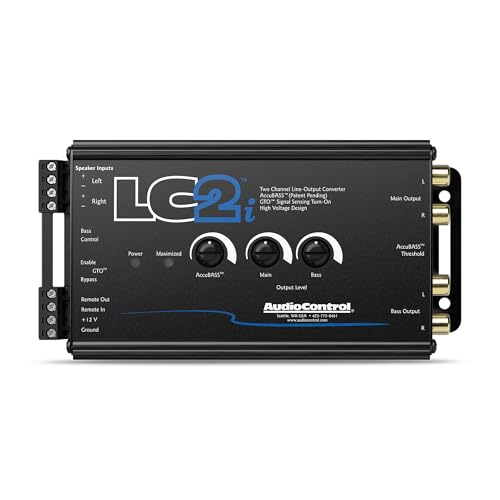
AudioControl LC2i with AccuBASS
$97.00An AccuBASS-equipped LOC actively restores low end that a factory head unit's volume-based bass rolloff has reduced.
Check price on AmazonHow do you wire an LOC to the factory speaker outputs step by step?
Disconnect the battery negative terminal before starting. Locate the factory speaker wires at the head unit connector or at the closest accessible speaker, and identify the correct pair for the channel you are tapping, using a multimeter or the LOC's included wiring guide to confirm polarity. Splice the LOC's speaker-level input wires into the factory speaker wires using solder or a proper crimp connector, keeping the factory speakers connected in the process if the vehicle still needs to use them.
Run RCA cable from the LOC's output to the amplifier's input, keeping the RCA run on the opposite side of the car from any power wire to avoid picking up noise. Connect the LOC's remote turn-on output, if it has one, to the amplifier's remote terminal, and ground the LOC to a clean chassis point nearby. Reconnect the battery and test at low volume first, checking for correct channel matching and no unexpected noise before turning things up.
Common mistakes when installing a line output converter
The most common mistake is buying a basic LOC without checking for a remote turn-on feature, then discovering the factory harness has no dedicated remote wire to use instead. A close second is tapping the wrong pair of factory speaker wires, which sends the wrong channel to the amplifier or mixes channels together. Running the new RCA cable alongside power wire is another frequent issue, introducing exactly the kind of noise the RCA-to-power-wire separation rule exists to prevent. Finally, ignoring factory bass rolloff and blaming the amplifier or the subwoofer for a thin-sounding system at volume is a common misdiagnosis that a bass-restoration LOC often solves directly.
Frequently asked questions
- What does a line output converter actually do?
- It converts a factory head unit's speaker-level output into RCA line-level signal that an aftermarket amplifier can accept as an input. Factory head units are built to drive speakers directly at a higher voltage than an amplifier's input expects, so the LOC steps that signal down (or up, in active designs) to the correct level.
- Do I still need a separate remote turn-on wire if I use an LOC?
- Not if you choose a signal-sensing LOC. Many current LOC models detect when the factory speaker output is carrying an audio signal and generate their own 12-volt remote turn-on signal from that detection, which eliminates the need to find or splice into a separate dedicated remote wire in the factory harness.
- Why does my amplified factory system sound thin when I turn the volume up?
- This is usually factory bass rolloff, an intentional feature where the head unit reduces low frequency output as volume increases to protect the factory speakers from overload. A basic LOC passes that same rolloff along to the amplifier, so the low end thins out at exactly the volume level where you would want more bass, not less.
- What is the difference between an active and a passive LOC?
- An active LOC uses a line driver circuit to raise the signal voltage, typically producing a stronger, cleaner output, especially from weaker factory speaker signals. A passive LOC simply divides the existing signal down without adding any active circuitry, which works but can be noisier or weaker depending on the source head unit's output strength.
- Where should I mount a line output converter?
- Mount it near where you tap the factory speaker wires, often behind the head unit or near the nearest accessible speaker connection, keeping the RCA output run separate from any power wire. Secure it somewhere it will not rattle or get pinched, and make sure the ground connection nearby is on clean, bare metal.
- Can I use a line output converter with a factory amplified system that already has a built-in amp?
- Yes, in many cases, though factory amplified systems can be trickier since the signal comes from the factory amplifier's output rather than a simple head unit. A signal-sensing LOC rated for higher input voltage, sometimes labeled for amplified factory systems specifically, handles this better than a basic model built for a non-amplified head unit.
Researched guidance, not professional advice. Factory wiring and signal characteristics vary widely between makes and models, and some factory amplified systems require specific LOC models to work correctly. Confirm compatibility with your specific vehicle before purchasing.