Tuning
Gain Setting Voltage for 2,000 Watts at 2 Ohms
Researched from published physics, alignment relations and manufacturer specifications. Updated .
Quick answer
Gain is an input sensitivity control, not a volume knob. Its job is to match the amplifier's input to the voltage your head unit actually sends, and setting it by ear is folklore: by the time distortion is audible your hearing has already been fatigued by the volume that got you there, and clipping is what burns voice coils.
The correct method takes a multimeter and five minutes. Target output voltage is V = sqrt(P x R), so 2,000 watts into 2 ohms is sqrt(2,000 x 2) = 63.25 volts. The gain setting calculator does it for any combination.
How to set the gain for 2,000 watts at 2 ohms
- Disconnect the speakers from the amplifier. You are measuring the amplifier's output, and a driver is not needed for it.
- Set every tone control, equalizer band, bass boost and loudness function to flat or off, at both the head unit and the amplifier.
- Turn the amplifier gain all the way down.
- Play a sine test tone from the source you actually use, at the frequency the channel will handle: 50 or 60 Hz for a subwoofer channel, around 1 kHz for a full range channel.
- Set the head unit to about three quarters of its maximum volume, which is roughly where most head units are still clean.
- Measure across the amplifier's speaker output terminals with the meter on AC volts.
- Raise the gain until the meter reads 63.25 volts. Stop there.
- Reconnect the speakers.
Three quarters volume is a convention, not a measurement. If you own an oscilloscope, the honest version is to find where the head unit output itself begins to clip and use that as the reference point instead.

Tresalto trim removal set, 5 piece
$7.95Nylon pry tools at under eight dollars, which is cheaper than one broken door card clip.
Check price on Amazon
AstroAI true RMS multimeter
$34.99True RMS at under thirty five dollars, which is the cheapest meter that will read a test tone correctly for gain setting.
Check price on Amazon
Poraxy 19 piece trim tool kit
$17.99Includes clip pliers, which are the tool that saves a door card when the clips are brittle.
Check price on AmazonTarget voltage for every common combination
The same relation across the loads and powers people actually run.
| RMS power | 1 ohm | 2 ohms | 4 ohms |
|---|---|---|---|
| 250 W | 15.81 V | 22.36 V | 31.62 V |
| 500 W | 22.36 V | 31.62 V | 44.72 V |
| 750 W | 27.39 V | 38.73 V | 54.77 V |
| 1,000 W | 31.62 V | 44.72 V | 63.25 V |
| 1,500 W | 38.73 V | 54.77 V | 77.46 V |
| 2,000 W | 44.72 V | 63.25 V | 89.44 V |
Published figure Source: Ohm's law and the series and parallel resistance relations. Use the amplifier's rated RMS power at the load you are actually presenting, which is not always the number printed largest on the box.
Which meter, and why it matters
Use a true RMS meter. A meter that is not true RMS is calibrated to read a 50 or 60 Hz sine correctly and progressively less correctly as the waveform departs from that, which for a subwoofer test tone at 50 Hz is mostly fine and for a 1 kHz full range tone often is not. A true RMS meter at around thirty five dollars removes the doubt entirely.
If your meter reads high, you will set the gain lower than intended, which is the safe direction. If it reads low, you will set the gain higher than intended and the amplifier will clip before you reach full volume. That asymmetry is the reason to spend the small amount of money on a meter you can trust.
Why clipping kills speakers and power does not
A clipped waveform is what burns voice coils, not wattage. When an amplifier runs out of rail voltage, the tops of the waveform flatten, and a flat-topped wave delivers far more average power to the coil than a clean sine of the same peak amplitude. It also generates high frequency content that a subwoofer cannot turn into motion, so it becomes heat in the coil instead. This is why an underpowered amplifier driven hard destroys more speakers than an oversized one driven gently.
After the gain is set
Set the low pass crossover on a subwoofer channel somewhere around 70 to 100 Hz, and set a matching high pass on the door speakers so they are not being asked to reproduce what they physically cannot. On a ported box, set the subsonic filter just below the box tuning frequency.
Leave bass boost alone. It is a fixed equalizer band, usually centred around 45 Hz, and it is the fastest way to undo the gain setting you just made. If you set the gain with bass boost at zero and then turn it up, you have raised the output at that frequency past where you calibrated.

GS Power 12 inch bar grille
$17.99A bar grille is the cheapest way to stop a foot going through a cone in a trunk.
Check price on Amazon
Recoil 12 inch concave grille
$21.99Concave, so it clears the excursion of a high excursion driver rather than fouling it.
Check price on AmazonMeters and tools for setting gain properly
Tresalto trim removal set, 5 piece
$7.95Nylon pry tools at under eight dollars, which is cheaper than one broken door card clip.
Check price on Amazon AstroAI true RMS multimeter
$34.99True RMS at under thirty five dollars, which is the cheapest meter that will read a test tone correctly for gain setting.
Check price on Amazon Poraxy 19 piece trim tool kit
$17.99Includes clip pliers, which are the tool that saves a door card when the clips are brittle.
Check price on Amazon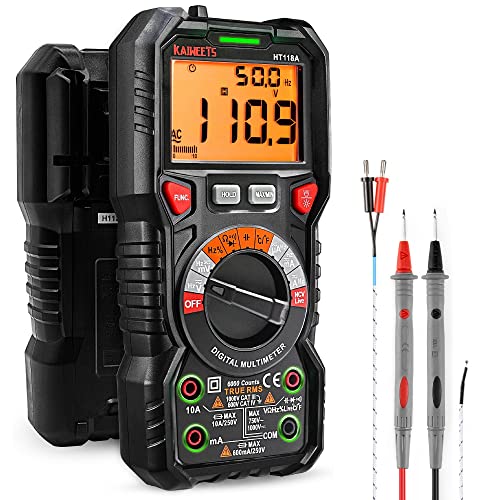
KAIWEETS automotive true RMS
$37.99True RMS with a non contact voltage function, aimed at automotive work rather than bench work.
Check price on AmazonFrequently asked questions
- What voltage should I set the gain to for 2,000 watts at 2 ohms?
- 63.25 volts AC, measured across the amplifier's speaker output terminals with a true RMS meter while a sine test tone plays and every filter is flat. The relation is V equals the square root of power times impedance, so 2,000 watts into 2 ohms gives 63.25 volts. Change either the power or the load and the target moves with it.
- Can I set the gain by ear instead?
- You can, and it is why so many voice coils fail. By the time distortion is clearly audible, your hearing has been fatigued by the volume that got you there, and on a subwoofer the audible cues for clipping are subtle in the first place. The multimeter method takes five minutes and gives a repeatable number rather than an impression.
- What frequency test tone should I use?
- Use 50 or 60 Hz for a subwoofer channel and around 1 kHz for a full range channel, and play it from the source you actually use so the head unit's own output stage is part of the measurement. Play it at a level you can tolerate briefly, disconnect the speakers first, and do not leave a test tone running any longer than the measurement takes.
- Should the head unit be at maximum volume?
- No. Most head units begin to clip their own output somewhere below maximum, so calibrating at full volume sets the gain against an already distorted signal. About three quarters is the usual convention. It is a convention rather than a measurement: with an oscilloscope you would find the actual point where the head unit output starts to clip and use that.
- Does turning the gain down reduce power?
- It reduces the power produced for a given input signal, which is exactly what it is for. Gain matches the amplifier's sensitivity to the voltage your source sends. Set correctly, the amplifier reaches its rated output at the head unit's maximum clean volume and not before, which is the whole point: full power available, with no clipping on the way there.
Hearing damage is permanent. Sustained exposure above roughly 100 dB causes measurable hearing loss within minutes, and the damage does not heal. A system capable of the numbers on this page is not one to sit inside at full output, and the fact that low frequencies feel less loud than they measure is exactly what makes them dangerous. Competition operators wear hearing protection and leave the vehicle for a reason.