Amplifiers
Class D vs Class A/B Car Amplifier: Which One Actually Fits Your System
Researched from published physics, alignment relations and manufacturer specifications. Updated .
Quick answer
Class D and class A/B describe how the output transistors in an amplifier switch on and off, not how loud the amplifier can play. The difference matters to a car audio install because it changes current draw, heat, physical size and, in a handful of cases, sound character. Most subwoofer amplifiers sold today are class D because a subwoofer channel needs raw current more than it needs finesse, while full range amplifiers are split between the two designs depending on price point and brand philosophy.
This comparison sticks to what changes in a real vehicle: the amps pulled from the electrical system, the heat that has to leave the amplifier case, and the wire and fuse sizing that follows from both. The efficiency figures below are planning conventions used across the industry, not laboratory measurements of any specific unit, and they are labeled that way throughout.
Does class A/B actually sound better than class D?
It used to. Early class D designs from the 1990s and early 2000s struggled with high frequency distortion and were mostly restricted to subwoofer duty for that reason, which is where the reputation comes from. Modern class D amplifiers use much faster switching and better filtering, and a well engineered class D full range amplifier is audibly competitive with class A/B at the same price point. The old objection is a legacy issue, not a rule that still applies to current production amplifiers.
Head to head
| Trait | Class D | Class A/B |
|---|---|---|
| Typical efficiency | About 80 percent | About 55 percent |
| Current draw at 14.4V for 1,000W RMS | About 87 amps | About 126 amps |
| Heat generated per watt delivered | Lower | Higher |
| Physical size for the same power | Smaller, lighter heatsink | Larger, heavier heatsink |
| Best duty | Subwoofer and full range | Full range, some purists |
Convention Source: Industry efficiency conventions; current draw derived from Ohm's law (I = P / V / efficiency). Efficiency percentages are planning conventions, not measurements of a specific amplifier model.
Why the current draw gap changes your wire and fuse
Higher current draw at the same output means bigger wire, sooner. The 39 extra amps a class A/B amplifier pulls compared to class D at 1,000 watts RMS can be the difference between a 4 gauge and a 2 gauge power run, and between a 100 amp fuse and a 150 amp fuse. Run your own numbers on the amp wire gauge calculator and the amp fuse calculator before you buy wire, because guessing in either direction either wastes money or undersizes a run that gets hot.
Heat and space are the practical difference
A class A/B amplifier turning 45 percent of its input power into heat needs a real heatsink to survive, which is why high powered class A/B amplifiers tend to be long, finned and heavy. Class D amplifiers dissipate less heat per watt delivered, so a 1,000 watt RMS class D monoblock can fit in a chassis a fraction of the size of an equivalent class A/B unit. In a trunk build where space is free this barely matters. Under a seat or behind a kick panel, it usually decides the class for you.
When class A/B still makes sense
Some listeners prefer the harmonic signature of a class A/B amplifier on midrange and highs, and a handful of home audio crossover brands that also make mobile amplifiers still ship class A/B designs for that reason. It also shows up in budget four channel amplifiers, where a simple class A/B topology can be cheaper to manufacture at modest power levels than a well filtered class D circuit. Neither reason is wrong, but neither one changes the electrical math above: a class A/B amplifier at a given RMS rating will always ask the electrical system for more current than a class D amplifier at the same rating.
What this means for subwoofer duty specifically
For a dedicated subwoofer channel, class D has effectively won. The efficiency advantage compounds as power climbs, so a 2,000 watt RMS monoblock in class D is a realistic, coolable product, while a 2,000 watt RMS class A/B monoblock would be enormous and would run hot enough to worry about long term reliability. That is why virtually every high power monoblock on the market, including everything in the monoblock vs multichannel comparison on this site, is a class D design.
Who should buy which

CT Sounds CT-1000.1D
$159.99A 1,000 watt RMS class D monoblock that matches the efficiency and current draw numbers in the table above, sized for a single subwoofer build.
Check price on Amazon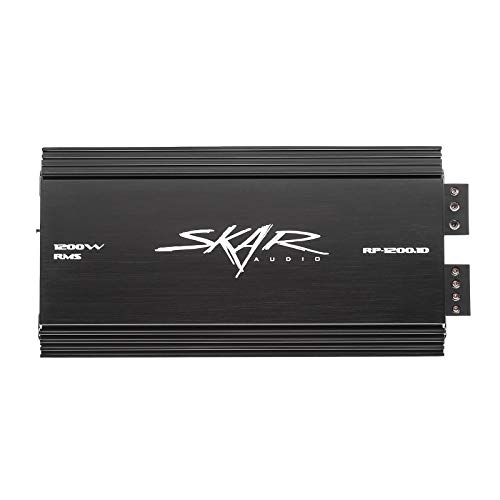
Skar Audio RP-1200.1D
Price varies, check the listingA higher output class D monoblock for builds that want headroom above 1,000 watts RMS without the heat penalty of a class A/B design at that power.
Check price on Amazon
Pioneer GM-A6704
$119.00A class A/B four channel amplifier for a full range build where a simpler, lower power topology is enough and space is not tight.
Check price on AmazonFrequently asked questions
- Is a class D amplifier less powerful than class A/B?
- No, the class describes the switching design, not the output ceiling. Class D amplifiers dominate the highest power monoblocks on the market precisely because their efficiency lets them push large numbers without overheating. A class A/B amplifier rated for the same RMS wattage will draw more current and run hotter, not deliver more usable power.
- Do class D amplifiers damage subwoofers more than class A/B?
- No, the damage risk comes from clipping and mismatched power, not from the amplifier class. A class D amplifier sending clean, properly gained power is no harder on a voice coil than a class A/B amplifier doing the same job. Set gain correctly with a multimeter or oscilloscope and the class of the amplifier is not a safety factor.
- Why do some car audio amplifiers still use class A/B?
- Cost and, for a smaller group of listeners, a preferred harmonic character on midrange and high frequencies. Simple class A/B circuits can be cheaper to build at modest power levels than a well filtered class D circuit, which is why some budget four channel amplifiers still use it. It remains a legitimate choice, just not the efficiency winner.
- Does class D efficiency change what alternator I need?
- It can. Lower current draw for the same output means a class D system asks less of the charging system, which matters most on builds already near the alternator's limit. Check total system draw against alternator output at idle using the alternator output calculator before assuming either amplifier class solves a charging shortfall on its own.
- Can I mix class D and class A/B amplifiers in one system?
- Yes, plenty of systems run a class D monoblock for the subwoofer and a class A/B amplifier for doors or a full range front stage. The two designs do not interact electrically beyond both drawing from the same power and ground system, so size the wire and fuse for each amplifier's own current draw and the mix works fine.
- Is class D amplifier heat really a non issue?
- It is a smaller issue, not a zero issue. A class D amplifier still generates some heat and still needs airflow, especially when driven hard for long periods. The difference is one of degree: a class D unit needs a modest heatsink where a class A/B unit at the same power needs a large one to avoid thermal shutdown.
Researched guidance, not professional advice. Efficiency and current draw figures here are planning conventions used across the car audio industry, and actual draw varies by amplifier design, load impedance and how hard the amplifier is driven. Confirm wire gauge and fuse size for your specific amplifier's rated current draw before wiring anything.