Subwoofers
10 Inch vs 12 Inch Subwoofer: Which Size Fits Your Build?
Researched from published physics, alignment relations and manufacturer specifications. Updated .
Quick answer
Ten inch and 12 inch subwoofers are the two most common sizes in car audio, and the difference between them is smaller than the difference in their labels suggests. Both are capable of tight, accurate bass or loud, room-filling output depending on the specific driver, the box it is loaded into, and the power feeding it. What genuinely changes between the two sizes is effective cone area, typical box volume, and how much low-frequency extension and output headroom a given design tends to offer.
This comparison sticks to what actually changes with size rather than treating either number as automatically better, and it points to the calculators and the driver's own spec sheet for the numbers that decide a real build.
Is a 12 inch subwoofer always louder than a 10?
Not automatically, but it usually has an easier time getting there. On representative effective cone area figures, a 12 inch driver moves roughly 82 square inches of air compared to about 57 square inches for a 10 inch driver, a meaningful difference that generally translates into more output potential for the same excursion and power, all else equal. But all else is rarely equal: power handling, motor strength, and box design vary enormously between individual driver models regardless of nominal size, so a well-built 10 inch system with the right box and enough power can outperform a poorly matched 12 inch system.
Cone area is the advantage size buys, not a guarantee. The driver's own Thiele-Small parameters and its enclosure recommendation are what actually determine how that cone area translates into real output in a specific box.
Head to head
| Characteristic | 10 Inch | 12 Inch |
|---|---|---|
| Effective cone area (representative) | About 56.7 sq in | About 81.7 sq in |
| Typical sealed box volume | Smaller, driver dependent | Larger, driver dependent |
| Packaging and fit | Easier in tight spaces | Needs more depth and width |
| Common RMS power range across catalog | 300 to 1,500 watts | 500 to 3,000 watts |
| Typical use case | Daily-driver trunks, tighter cabins | Larger cargo areas, more output headroom |
Convention Source: Cone area figures are representative conventions; RMS ranges reflect commonly available driver models and vary by product.. Power handling and box volume are set by the specific driver's spec sheet, not by nominal size alone.
Size is a starting point, not the whole spec
Two drivers of the same nominal size can have very different power handling, sensitivity, and box requirements. A 10 inch driver built around a large motor structure can outperform a lightly built 12 inch driver in the same box volume. The nominal size only sets an approximate cone area range; the manufacturer's published Thiele-Small parameters and recommended enclosure volume for the exact model are what actually determine performance in a real install.
Where a 10 inch driver wins
A 10 inch subwoofer packages into a noticeably smaller box, which matters in a hatchback, a small sedan trunk, or any install where cargo space is already tight. Smaller drivers are also common in shallow-mount form for under-seat or tight enclosure installs, and even in a standard-depth 10, the smaller basket and shorter overall enclosure requirement make it the easier fit when space, not output, is the binding constraint. For a daily-driven vehicle where the trunk still needs to carry groceries and luggage, a well-chosen 10 inch driver in a correctly sized box is often the more livable answer.
Where a 12 inch driver wins
A 12 inch driver's larger cone area gives it more headroom to work with at a given excursion, which generally shows up as more output potential and, in many designs, somewhat lower distortion at high power for the same target SPL, since the larger cone does not have to move as far to displace the same volume of air. For anyone chasing higher output numbers or building a system meant to compete on loudness, the larger cone area is a real, physics-based advantage, provided the vehicle has the box volume to support it.
Who should buy which

CT Sounds Bio 10 D2
$69.99A 10 inch driver suited to tighter trunks or hatchbacks where box volume is the limiting factor and a smaller footprint matters more than maximum output.
Check price on Amazon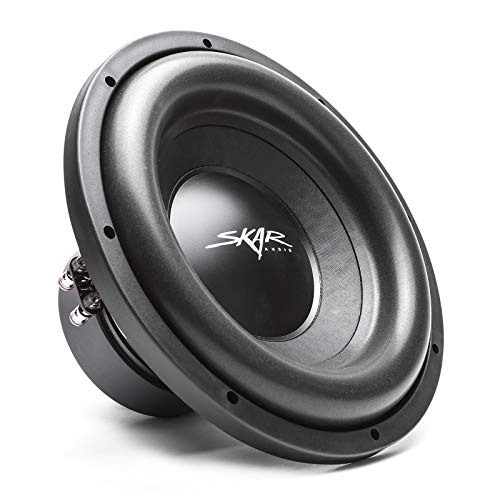
Skar Audio SDR-12 D4
Price varies, check the listingA 12 inch driver for builds with more available cargo space where the larger cone area's output headroom is the priority.
Check price on Amazon
Pioneer TS-A25S4
$64.81A second 10 inch option for a shallower motor structure in tighter mounting locations while still keeping the smaller-box advantage of the size.
Check price on AmazonFrequently asked questions
- Is a 10 inch or 12 inch subwoofer better for a small car?
- A 10 inch subwoofer is usually the easier fit for a small car because it needs a smaller box, which matters when trunk or cargo space is already limited. A well-chosen 10 inch driver in a correctly sized enclosure can still produce strong, accurate bass; the size tradeoff is packaging, not automatically sound quality.
- How much more output does a 12 inch subwoofer give over a 10?
- On representative cone area alone, a 12 inch driver has roughly 44 percent more effective radiating area than a 10 inch driver, which generally supports more output potential at the same excursion. Actual output also depends heavily on the specific driver's power handling and motor strength, so the size difference alone does not set the final number.
- Do 10 inch subwoofers need less power than 12 inch subwoofers?
- Not inherently. Power handling is set by the individual driver's voice coil and motor design, not strictly by cone size, and there are 10 inch drivers rated well above some 12 inch drivers. The recommended power range should always come from the specific model's spec sheet rather than an assumption based on nominal diameter.
- Can I swap a 10 inch subwoofer for a 12 inch in the same box?
- Only if the box's net volume, after subtracting the new driver's displacement, still matches that driver's recommended enclosure volume. A box sized correctly for a 10 inch driver's displacement and recommended volume will rarely be correct for a 12 inch driver, which typically wants more net volume and has a different displacement figure.
- Which subwoofer size is more common in factory-style upgrade installs?
- Both sizes are common, but 10 inch drivers show up more often in factory-location swaps and shallow enclosures where the vehicle's existing subwoofer location is size-constrained and depth is limited. 12 inch drivers are more common in aftermarket boxes built specifically for a trunk or cargo area with more available room to work with.
Researched guidance, not professional advice. Cone area figures here are representative conventions for planning, not a spec for any single driver. Confirm power handling and recommended enclosure volume on the exact model's data sheet before building or buying a box.