Intermediate build
A Pickup Truck Bass Build
Researched from published relations and manufacturer specifications. Updated .
Quick answer
A truck has no trunk, so the enclosure has to be shaped for the cab rather than boxed in the open. A vehicle specific box under the rear seat recovers volume a rectangular enclosure in the same space would waste, and a crew cab will usually take a full depth driver where an extended cab needs a shallow one.
Every other build on this site assumes a trunk or a hatch. A pickup has neither, and the space under the rear seat is an awkward shape that a rectangular box uses badly.
That is what vehicle specific enclosures are for. They recover volume a generic box wastes, and on a truck that difference is often the whole margin between a driver working properly and not. The catch is fitment: these boxes fit certain listed cabs and nothing else, so check the listing against your own year, cab style and body before ordering anything here.
The complete parts list
Grouped by function rather than by price, so you can see what each part of the system costs on its own. Every line links to the product, and the total is computed from catalog prices rather than typed by hand.
Enclosure and driver
$294.78-
 American Sound Connection
ASC dual 12 for 2007 to 2013 GM ext cab
A dual 12 box shaped for a specific extended cab. CHECK THE FITMENT LIST against your own truck before ordering.
-
 Skar Audio
Skar Audio VS-12 D2 shallow
A shallow mount dual 2 ohm 12, for a cab that will not take a full depth motor.
Price varies Check price -
 PIONEER
Pioneer TS-A3000LS4 shallow 12
An alternative shallow 12 from a manufacturer that publishes a mounting depth and a recommended volume.
Amplification
$178.99-
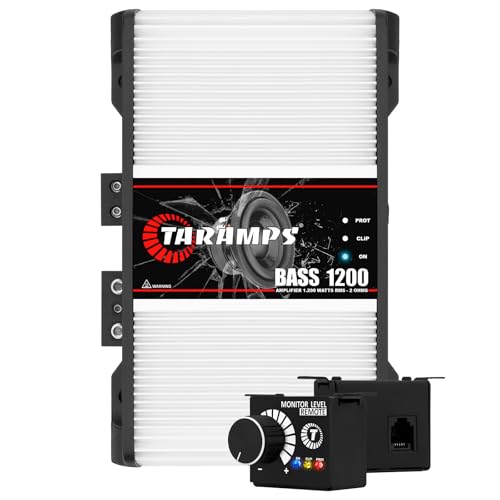 Taramp's
Taramps Bass 1200
A published 1,200 watt RMS at 1 ohm, which is the load two dual 2 ohm drivers reach easily.
-
 Skar Audio
Skar 17 ft twisted pair
Twisted pair interconnect, run down the opposite side of the cab from the power wire.
Price varies Check price -
 Taramp's
Taramps universal bass knob
Works over RCA rather than a proprietary plug, so it suits amplifiers with no dedicated remote input.
Power, and trucks need more of it
$374.92-
 AUDIO360
Audio360 AD0C true spec
True spec 0 AWG with a 17 foot run and two fuse values. A truck run from battery to cab is longer than it looks.
-
 NVX
NVXNVX True Spec 1/0 100 percent OFC
A hundred percent OFC big 3. Trucks carry heavier factory electrical loads, so the charging path is already working harder.
-
 XS Power
XS Power D680
A 20 amp hour deep cycle power cell. Not a starting battery: anything rated in cold cranking amps is the wrong part.
-
 Sky High Car Audio
Sky High copper lugs with heat shrink
Proper copper lugs with adhesive lined heat shrink.
Tools
$95.97-
-
 Brileine
Brileine 10 ton hydraulic crimper
Hydraulic crimps on 1/0 are repeatable in a way hammer crimps are not, and this build has several to make.
-
 Poraxy
Poraxy 19 piece trim tool kit
Rear seat and sill trim comes out first on every truck install.
Build total
$944.6613 lines across 4 groups. 2 items returned no price from the catalog and are not included in this figure, so the real total is higher. Prices change often and are a guide only.
What you can skip
Telling you not to buy something is what makes the rest of this list worth reading. On this build, these are the things people add that are not earning their place.
- A ported box, in most extended cabs. There is rarely enough volume for one to work properly, and a sealed box in the space available beats a compromised ported box.
- A capacitor. On a truck with a large factory alternator, the big 3 upgrade usually clears the sag on its own.
- A generic rectangular box. In a cab it wastes exactly the volume the driver needs.
What to upgrade first
When the budget comes back around, this is the order that gets the most for the money.
- Sound deadening on the rear cab wall and the floor. A truck cab is loud and the panel behind the box is thin.
- A high output alternator, if the truck is a work vehicle running lights and a winch as well.
- Door speakers, since truck doors are large and usually have a factory speaker that never had a chance.
Frequently asked questions
- Do I need a shallow mount subwoofer in a truck?
- It depends entirely on the cab. A crew cab usually has enough depth under the rear seat for a full depth driver, while an extended cab often does not. Measure the available depth behind the seat before choosing, because the mounting depth is a published figure on the driver specification and it is the one that decides whether the build is possible at all.
- Will a vehicle specific box fit my truck?
- Check the fitment list on the listing against your own year, cab style and body, and do not assume. Cab shapes change between generations that look similar from outside, and a box for a 1999 to 2006 extended cab does not fit a 2007 to 2013 one despite both being extended cabs. We cannot tell you whether a given box fits your truck.
- Is under seat the best place for a subwoofer in a truck?
- It is usually the only place with usable volume, and it works better than it sounds like it should. The cab is small and well sealed, which gives strong cabin gain at low frequencies, so a modest enclosure under the seat produces more than the same box would in a sedan trunk. Firing the driver into the cab rather than the seat back matters.
- Why does a truck need heavier wire than a car?
- Mostly because the run is longer. The battery is under a long hood and the amplifier is behind the rear seat, so the one way distance is often several feet more than in a sedan. Voltage drop scales directly with distance, so the same amplifier in a truck needs a larger conductor than it would in a hatchback to reach the same voltage at the amplifier.
Researched guidance, not professional advice. A car battery will deliver several hundred amps into a short without any drama at all. Fit the main fuse within 18 inches of the battery positive terminal, because that fuse protects the wire and the wire is what starts a fire. Disconnect the battery negative before running power wire, fit a grommet anywhere a cable passes through sheet metal, and keep cables away from steering, airbag and moving components. Sustained high sound pressure causes permanent hearing damage.
Build list
Get the parts list as a checklist
One email with the full build list, every part linked. Nothing else.
No spam. Unsubscribe whenever you like.