Enclosures
What Size Ported Box for 3 12 Inch Subwoofers?
Researched from published physics, alignment relations and manufacturer specifications. Updated .
Quick answer
This page answers one question: how much air do 3 12 inch subwoofers need behind them in a ported box? The short version is 5.25 to 8.25 cubic feet net, in total, across all 3 drivers.
The longer version matters more. Two 12 inch drivers from different manufacturers can want enclosure volumes that differ by a factor of two, because the number that sets enclosure volume is the driver's compliance, not its diameter. Run your own driver's published parameters through the ported box volume calculator and use that figure, and use the range on this page only to sanity check it or to plan a space before you have chosen a driver.
How many cubic feet for 3 12 inch subs?
Net internal volume is the air the driver actually sees, after the driver itself, the port and any bracing have taken their share. These are typical published ranges by nominal size.
| Drivers | Sealed, net | Ported, net | Typical ported tuning |
|---|---|---|---|
| 1 driver | 1 to 1.75 cu ft | 1.75 to 2.75 cu ft | 30 to 35 Hz |
| 2 drivers | 2 to 3.5 cu ft | 3.5 to 5.5 cu ft | 30 to 35 Hz |
| 3 drivers | 3 to 5.25 cu ft | 5.25 to 8.25 cu ft | 30 to 35 Hz |
| 4 drivers | 4 to 7 cu ft | 7 to 11 cu ft | 30 to 35 Hz |
Convention Source: Typical ranges compiled across published manufacturer enclosure recommendations for this nominal size. These are planning ranges, not specifications. Drivers of the same nominal size routinely differ by a factor of two, and the manufacturer figure for your exact model is the one to build to.
Where the ported number actually comes from
Vented volume and tuning come from the same parameters. The quasi-Butterworth third order alignment gives Vb = 20 x Vas x Qts^3.3 and Fb = 0.42 x Fs x Qts^-0.96. It only describes a useful vented box over roughly Qts 0.2 to 0.5, and a driver above that range generally wants a sealed enclosure instead.
Worked through with a representative 12 inch driver, Vas 1.2 cubic feet, Qts 0.42 and Fs 32 Hz, QB3 asks for 1.371 cubic feet per driver tuned to 30.9 Hz, with a predicted F3 of 28 Hz. Those parameters are an example rather than any particular product's specification.
Tuning lower extends the low end and costs output above tuning. Tuning higher is louder over a narrower band. Below the tuning frequency the driver unloads and excursion rises sharply, which is why a ported box needs a subsonic filter and a sealed box does not.
How much port does 3 12 inch drivers need?
Port area is usually quoted as square inches per cubic foot, which is a convention. The defensible test is air velocity through the port, because that is what makes the chuffing noise people are actually trying to avoid.
| Round port diameter | Port area | Length required |
|---|---|---|
| 3 inch | 7.1 sq in | 1.33 in |
| 4 inch | 12.6 sq in | 2.92 in |
| 5 inch | 19.6 sq in | 5.07 in |
| 6 inch | 28.3 sq in | 7.79 in |
Published figure Source: The Helmholtz resonator relation, in the form commonly published for vented loudspeaker enclosures: Lv = (1.463e7 x R^2) / (Fb^2 x Vb) minus the end correction. Port length rises with the square of the port radius, so a larger port is always a longer one, and at some point it will not physically fit inside the box it is tuning. Where a row has no answer, the opposite has happened: the port is too small in area for this volume and tuning, and the length the relation asks for has collapsed to zero. Both are real constraints rather than calculation errors.
Gross volume, net volume, and the difference that catches people out
Every manufacturer enclosure recommendation is a net figure. Net volume is the gross internal volume of the box less the driver displacement, less the port displacement on a vented box, and less any bracing. On a 8.25 cubic foot ported build, the drivers alone can take 0.24 to 0.54 cubic feet and the port can take another 0.2 to 0.5 cubic feet on its own.
Driver displacement is a published number on the specification sheet and it cannot be worked out from the nominal size. If you do not have it, you cannot compute net volume, and the net volume calculator will tell you so rather than substituting a guess. Work out the gross internal volume of your panel dimensions with the box dimensions calculator first.
Prebuilt boxes for 3 12 inch subs
A prebuilt box is a reasonable choice, with one condition: it has to state its internal volume. Many listings do not, and the internal volume is the single most important number about an enclosure. Where a box states its volume, check that figure against what your driver's manufacturer publishes before buying either one.
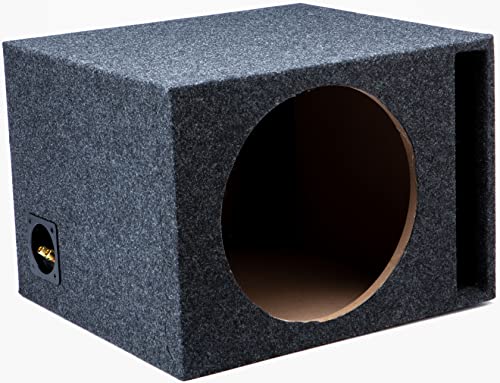
ASC single 12 ported box
$54.95A plain 5/8 inch MDF vented box, which is the cheapest starting point if you are not building your own.
Check price on Amazon
Maxxlink MBXP-112
$54.99A universal fit vented 12 box with UV treated carpet, aimed at a hatch or trunk install.
Check price on Amazon
QPower HD112VL side ported
$77.49A side ported design, which packages into a trunk corner better than a front ported box of the same volume.
Check price on Amazon12 inch subwoofers with published specifications

CT Sounds Tropo 12 D4
$129.99A dual 4 ohm 12 that wires to 8 or 2 ohms with one driver, which keeps the amplifier choice open.
Check price on Amazon
Orion Cobalt CBW124D
$74.95The cheapest dual 4 ohm 12 in this catalog from a brand that has published specifications.
Check price on Amazon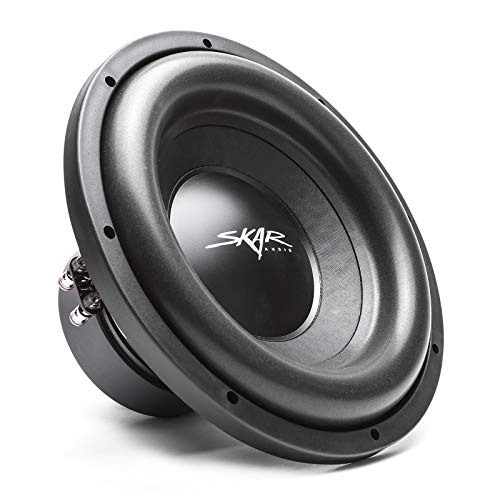
Skar Audio SDR-12 D4
Price varies, check the listingA 2.5 inch four layer coil and a published 22 Hz to 300 Hz response, which is the usual first real subwoofer.
Check price on Amazon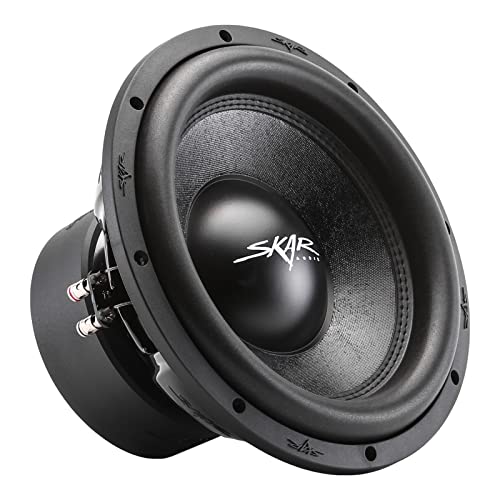
Skar Audio SVR-12 D4
Price varies, check the listingA step up in motor and excursion from the SDR at the same coil configuration, so an existing box often still suits it.
Check price on AmazonFrequently asked questions
- How many cubic feet does 3 12 inch subwoofers need?
- In a ported enclosure, 3 12 inch drivers typically need 5.25 to 8.25 cubic feet of net internal volume in total. That is a planning range rather than a specification. The real figure comes from the driver's own Vas and Qts, and two drivers of this nominal size can genuinely want volumes that differ by a factor of two, so always check the manufacturer recommendation for your exact model.
- Is a bigger box always better for a subwoofer?
- No. In a sealed box, a larger volume lowers the system Q, which gives a flatter response and lower extension but less output near resonance and more excursion for the same power. In a ported box, too much volume with the same tuning changes the alignment away from what the driver suits and can leave a peak followed by a steep rolloff. Bigger is a trade, not an upgrade.
- What happens if the box is too small?
- A sealed box that is too small raises the total system Q, which produces a peak near resonance and a leaner, boomier sound that rolls off early. It also stiffens the air spring, which limits excursion at low frequencies but concentrates output in a narrow band. A ported box that is too small for its tuning ends up with a port so long it will not fit, which is usually the first sign something is wrong.
- Does the number of drivers change the volume per driver?
- No. Each driver needs its own share of net volume, so 3 drivers need 3 times the single-driver figure. Whether they share one chamber or get separate chambers is a different question: separate chambers protect you if one driver fails, while a shared chamber is simpler to build and is what most prebuilt multi-driver boxes use.
- What tuning frequency should I use for 12 inch subwoofers?
- Typical tuning for this size falls between 30 and 35 Hz. Lower tuning extends the low end and gives up output above tuning; higher tuning is louder over a narrower band and is what competition builds use. Whatever you choose, fit a subsonic filter just below the tuning frequency, because the driver unloads below tuning and excursion rises very quickly there.
Build it to the driver, not to a rule of thumb. The only enclosure volume that governs is the one the driver manufacturer publishes for that exact model. A box that is meaningfully too small raises the system Q and can drive a subwoofer past its excursion limit at frequencies it should handle easily, and a ported box that is too large or tuned too low unloads the cone below tuning. If your driver does not publish a recommended volume, use its Thiele/Small parameters in the calculators rather than a figure taken from a driver of the same nominal size.