Amplifiers
Best Monoblock Car Amplifiers
Researched from published physics, alignment relations and manufacturer specifications. Updated .
Quick answer
A monoblock amplifier does one job: it pushes power to a subwoofer, or a pair of them wired to a single load. Because it only has to drive bass frequencies, a monoblock can be built for maximum low-end output per dollar instead of splitting its power supply across four or five channels. That focus is also why the spec sheet matters more here than almost anywhere else in a car audio system. A monoblock's RMS rating at a specific impedance, usually 1, 2, or 4 ohms, tells you what it can actually deliver, while the peak or "max" number printed in bigger type on the box tells you very little.
This list is organized by tier so a first subwoofer upgrade and a competition-leaning build aren't judged against the same yardstick. Beginner picks favor simplicity and forgiving install requirements, intermediate picks add more sustained power and better ohm stability, and expert picks are built for low-impedance loads and continuous high demand. Whichever tier fits your build, the amp is only half the job. Wire gauge, fuse placement, and a clean ground all determine whether the rated power actually reaches the subwoofer.
How we chose
We did not install, bench test, or listen to any of these amplifiers ourselves. This list is built from manufacturer-published specifications, the impedance stability each maker states for their own product, and how each amplifier is positioned within its own lineup (entry-level, mid-tier, or flagship). We did not run our own power measurements, and we are not claiming to have verified any manufacturer's RMS number on a bench. Where a spec isn't published, we say so instead of guessing.
Tiering is based on published power, stated impedance stability, and included features like a bass remote, not on brand reputation or price alone. A cheaper amp with a clearly documented RMS rating ranked ahead of a pricier one with vague marketing claims in our evaluation.
RMS is not peak: reading a monoblock's spec sheet
CTA-2006 (formerly CEA-2006) is the published industry standard for rating mobile amplifier power. It defines RMS output as the continuous power an amplifier produces at 1 percent total harmonic distortion plus noise (THD+N), into a stated impedance, at a 14.4 volt supply. That's a specific, repeatable test condition. When a manufacturer publishes a CTA-2006 RMS number, or a number they describe the same way, you're looking at something measured against a fixed method.
Peak power and "max power" figures are a different story. There is no standard test behind them, and no fixed ratio between peak and RMS. One manufacturer's "2000 watt max" amplifier might be a 500 watt RMS amp, while another's might be closer to 1000 watts RMS. Ignore the peak number entirely when comparing amplifiers and match your subwoofer's RMS rating against the amplifier's RMS rating at the impedance you plan to wire it to.
Published RMS power at a glance
| Amplifier | Published RMS power | Tier |
|---|---|---|
| Skar RP-800.1D | Per model number, unconfirmed on our end | Beginner |
| CT Sounds CT-1000.1D | 1000W RMS | Intermediate |
| Taramps Bass 1200 | 1200W RMS at 1 ohm | Intermediate |
| Stetsom Bravo 1200 | 1200W RMS, stable at 1 ohm | Expert |
| Skar RP-2000.1D | Per model number, unconfirmed on our end | Expert |
Published figure Source: Manufacturer-published RMS specifications, referenced against CTA-2006 test conditions where a maker states them. Where we could not confirm a manufacturer's published RMS figure directly, we say so rather than treating the model number as a verified spec. Peak or max wattage figures are not included here because they are not measured to any fixed standard.
Buying tips
- Match the amplifier's RMS rating at your planned wiring impedance to the subwoofer's RMS rating, not to the peak number on either box.
- Check the amp's minimum stable impedance before wiring a dual voice coil subwoofer down to 1 ohm; not every amplifier is rated stable that low.
- Use an amp wire gauge calculator to size power and ground wire to the amplifier's actual current draw, not a generic "one size fits all" kit.
- Size the main fuse to protect the wire with an amp fuse calculator, since the fuse's job is protecting the cable, not the amplifier.
- A bass remote is worth paying for on a daily-driven vehicle; adjusting gain from the driver's seat beats popping a trunk to touch a knob.
- Set gain with a multimeter or an oscilloscope method, not by ear, using a gain setting calculator as a starting point.
Fuse and wiring safety
A fuse protects the wire, not the amplifier. The main fuse is sized to what the power wire can safely carry, and it belongs within 18 inches of the battery's positive terminal. If a wire shorts against the chassis before it reaches that fuse, there's nothing protecting it from a direct short to a car battery, which is a fire risk. Size the fuse with the wire gauge in mind, not the amplifier's wattage alone.
Matching a monoblock to your subwoofer and wiring
Once you've picked an amplifier, the wire between the battery and the amp determines how much of that rated power actually shows up at the subwoofer. Undersized wire adds resistance, and resistance turns electrical power into heat instead of bass. Run the amp's rated current draw, roughly RMS watts divided by the product of amplifier efficiency and 14.4 volts, through an amp wire gauge calculator before buying a wiring kit off the shelf.
If you're seeing dim headlights or a flickering dash under bass hits, resist the urge to reach for a capacitor first. The better order of operations is a big 3 upgrade to your factory charging wires, then a second battery if the system is large, then a higher output alternator if you're running a genuinely high-power build. A capacitor is a small, fast-discharging buffer, not a fix for a charging system that's actually undersized for the amplifier you installed.
The picks, by tier

Skar Audio RP-800.1D
Price varies, check the listingComes with a bass remote in the box, which is the single most useful accessory on a first subwoofer build since it lets you adjust bass level from the driver's seat instead of popping a hatch to touch the gain knob.
Check price on Amazon
Skar Audio SA-1000.1D
Price varies, check the listingA straightforward single-channel design that keeps the install simple for a first amplifier, without the dual-input switching or advanced crossover options that can complicate a beginner build.
Check price on Amazon
CT Sounds CT-1000.1D
$159.99CT Sounds publishes a 1000 watt RMS figure for this model, which gives you a documented number to match against a subwoofer's RMS rating instead of guessing off a peak spec.
Check price on Amazon
Taramps Bass 1200
$159.00Rated at 1200 watts RMS at 1 ohm, which puts it ahead of many amps in its price range once you're wiring a dual voice coil subwoofer down to a low impedance.
Check price on Amazon
Stetsom Bravo Bass 1200
$159.99Published at 1200 watts RMS and listed as stable at 1 ohm, which is the load most single-subwoofer builds land on and the one where cheaper amps tend to run hot or protect out.
Check price on Amazon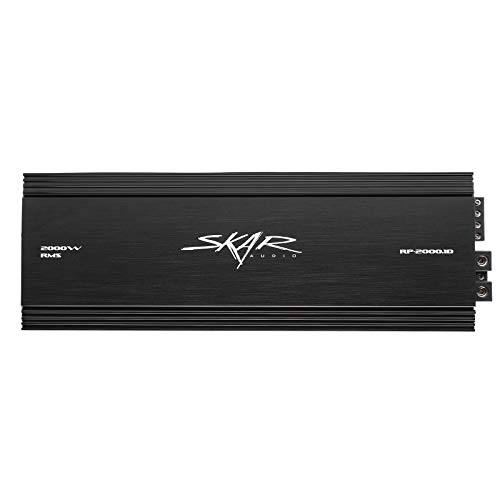
Skar Audio RP-2000.1D
Price varies, check the listingThe largest amplifier in Skar's RP monoblock line by model number, aimed at builds running two subwoofers or a single high-power sub that needs more current than a 1000 or 1200 watt amp can supply.
Check price on AmazonFrequently asked questions
- What does RMS power actually mean on a monoblock amplifier?
- RMS is the continuous power output an amplifier can sustain, tested at 1 percent distortion into a stated impedance at 14.4 volts under the published CTA-2006 standard. It's the number to match against a subwoofer's own RMS rating. Peak or max wattage figures aren't tested to any fixed method and can vary wildly between brands, so they aren't useful for comparing two amplifiers against each other.
- Is more RMS power always better for a subwoofer setup?
- No. An amplifier should be matched to what the subwoofer is rated to handle at your wiring impedance, not maximized regardless of the driver. Feeding a subwoofer far more continuous power than its RMS rating risks mechanical failure, while underpowering it risks clipping distortion, which can also damage a voice coil. Match RMS to RMS at the impedance you're actually wiring to.
- What size fuse does a monoblock amplifier need?
- The fuse is sized to the power wire's safe current-carrying capacity, not directly to the amplifier's wattage, and it needs to sit within 18 inches of the battery's positive terminal. Use an amp fuse calculator with your actual wire gauge and the amplifier's expected current draw to land on the right fuse size rather than guessing or copying a number from an unrelated build.
- Do I need a capacitor with a monoblock amplifier?
- Usually not as a first step. A capacitor stores a small amount of energy and discharges it in a fraction of a second, which does little for a charging system that's genuinely undersized. If you're seeing dimming lights, a big 3 upgrade, a second battery, or a higher output alternator address the actual cause far more effectively, in that order, before a capacitor is worth considering.
- Can I bridge a 4-channel amplifier instead of buying a monoblock?
- Some 4-channel amplifiers can be bridged to run a subwoofer, but only if the manufacturer specifically rates that amplifier as bridgeable and states the resulting impedance and power. A dedicated monoblock is generally the better tool for a subwoofer because its entire power supply is built around one low-impedance load instead of being split for speaker duty.
- How do I know if an amplifier is stable at 1 ohm?
- Check the manufacturer's own spec sheet for a stated minimum stable impedance, which is usually listed alongside the RMS power chart for each load. Wiring a dual voice coil subwoofer down to 1 ohm on an amplifier that isn't rated stable there risks the amp overheating or shutting down under load, even if it technically powers on and plays music at low volume.
Researched guidance, not professional advice. We compiled this list from published manufacturer specifications rather than in-person testing, and every electrical system is different. Confirm wire gauge, fuse size, and impedance stability against your specific amplifier and subwoofer before wiring anything, and when in doubt about a charging system upgrade, have the work checked by someone who installs car audio systems for a living.