Install
Best Line Output Converters (LOC) in 2026
Researched from published physics, alignment relations and manufacturer specifications. Updated .
Quick answer
A line output converter, or LOC, taps into a factory speaker wire's signal and converts it down to the RCA-level signal an aftermarket amplifier expects. It exists because most factory head units do not have RCA preamp outputs at all, or the ones they do have are already processed by the factory's own sound settings in ways that do not translate well to a separate amplifier.
Not every LOC does the same job. A passive LOC is a simple voltage divider: cheap, reliable, and fine for a factory system that was not heavily equalized or bass-managed at the factory. An active LOC includes its own circuitry to restore level and, on some models, restore bass that a factory unit rolled off before it ever reached the speaker wire. The picks below split by that distinction as much as by tier, since the right choice depends more on how the specific factory system was tuned from the factory than on how much a buyer wants to spend.
How we chose
We did not wire any of these units into a vehicle ourselves. Picks are based on published channel count, whether the unit includes a remote turn-on output, which saves running a separate trigger wire, and whether it is a passive or active design, compared against what factory-radio upgrade guides commonly recommend for each situation.
Passive vs active: what the difference actually fixes
A passive LOC steps a speaker-level signal down using resistors, with no power input and no active circuitry. It works well when the factory head unit's output is close to a flat, unprocessed signal, which is common on simpler factory systems. The tradeoff is that a passive LOC cannot correct for anything the factory unit already did to the signal, including bass that was rolled off to protect small factory speakers from overexcursion.
An active LOC has its own power connection and circuitry, which lets it boost a weak signal cleanly and, on units built for it, restore bass response that a factory-processed system removed before the signal ever reached the speaker wire. That correction matters most on factory systems known for aggressive processing, where a passive LOC would just faithfully pass along a signal that was already missing low end.
Channels, turn-on output, and special features
| LOC | Type | Channels | Remote turn-on output | Notable feature |
|---|---|---|---|---|
| Scosche LOC80 | Passive | 2 | No | Basic, budget |
| Kicker KISLOC2 | Passive | 2 | Yes | Built-in remote turn-on output |
| Scosche LOC2SL | Passive | 2 | Not published | Level knob for input matching |
| CT Sounds LC2 | Passive | 2 | Not published | BassLift circuit |
| AudioControl LC1i | Active | 1 | Yes | Active line driver |
| AudioControl LC2i | Active | 2 | Yes | AccuBASS bass restoration |
Published figure Source: Manufacturer product listings as published. A built-in remote turn-on output can save running a separate trigger wire from an ignition source, but check that its output can actually switch the amplifier being paired with it.
Buying tips
- Check whether the factory system uses heavy bass management or a factory subwoofer; those setups usually benefit more from an active LOC with bass restoration than a plain passive unit.
- A LOC with a built-in remote turn-on output can save running a separate trigger wire, but confirm its output rating matches the amplifier's remote input current draw.
- Level-adjustable LOCs help match a wide range of factory head unit output levels without relying on the amplifier's gain alone to compensate.
- Tap the signal at the speaker wire closest to the head unit when possible, before any factory amplifier or processing module further down the harness.
- Two-channel LOCs cover a stereo signal; a fully active multi-speaker build needs a LOC per pair or a DSP with built-in speaker-level inputs instead.
The remote turn-on wire still matters
A LOC converts the audio signal, not the power-on signal. Most aftermarket amplifiers still need a remote turn-on wire connected to a source that switches on with the ignition or the factory radio, and a LOC without a turn-on output does not provide that. Confirm how the amplifier will get its turn-on signal before assuming a LOC install is complete.
Where to tap the signal
The cleanest tap point is the factory speaker wire pair closest to the head unit itself, before it reaches any factory amplifier, sound processing module, or the door speaker. Tapping further down the harness risks pulling a signal that has already passed through factory equalization or a factory amplifier's own output stage, which a LOC then just passes along unchanged. A factory wiring diagram or a harness adapter built for the specific vehicle usually identifies the correct wire pair without needing to cut into the factory harness.
On vehicles with a factory amplifier built into the dash or under a seat, tapping ahead of that amplifier at the head unit's own low-level output, where one exists, generally gives a cleaner starting point than tapping at the speaker itself. A plug-and-play harness adapter for the specific make and model usually exposes that point without any wire cutting, which is worth checking before reaching for a test light and a set of strippers.
The picks, by tier

Scosche LOC80
$9.99A basic passive 2-channel LOC, a reasonable starting point on a simple factory system that was not heavily equalized or bass-managed at the factory.
Check price on Amazon
Kicker 46KISLOC2
$19.99A passive LOC with a built-in remote turn-on output, which can save running a separate trigger wire on a straightforward single-amplifier install.
Check price on Amazon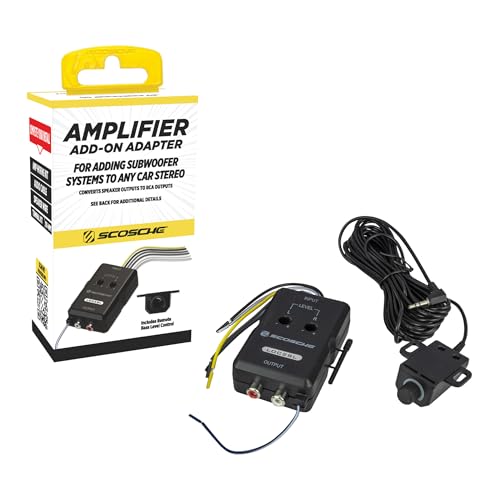
Scosche LOC2SL
$19.97A level knob lets this passive LOC match a wider range of factory head unit output levels, useful when the factory signal runs hotter or weaker than typical.
Check price on Amazon
CT Sounds CT-LC2 with BassLift
$49.99A BassLift circuit gives this passive LOC some ability to boost low end, a middle ground between a plain passive unit and a fully active line driver.
Check price on Amazon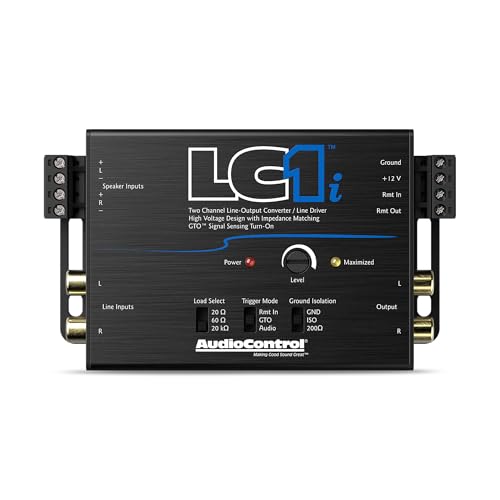
AudioControl LC1i
$65.00A single-channel active line driver for a build that only needs to convert one factory signal, such as feeding a single subwoofer amplifier from a factory front-stage tap.
Check price on Amazon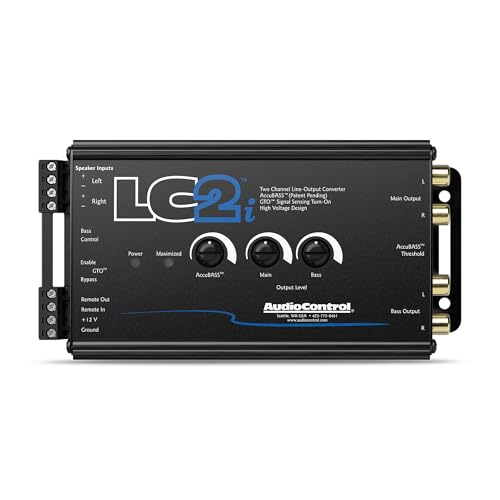
AudioControl LC2i with AccuBASS
$97.00AccuBASS bass restoration on a 2-channel active line driver targets factory systems known for rolling off low end before the signal ever reaches the speaker wire.
Check price on AmazonFrequently asked questions
- Do I need an active or passive LOC?
- A passive LOC works fine when the factory head unit outputs a relatively unprocessed signal, which is common on simpler factory radios without a subwoofer or heavy equalization. An active LOC is the better choice on factory systems known for aggressive bass management or heavy processing, since it can restore level and, on some models, bass response that a passive unit simply cannot add back.
- Can a LOC replace running new speaker wire?
- No, a LOC does not touch the speaker wiring at all. It taps the existing factory speaker wire's signal and converts it to an RCA-level signal for an amplifier, while the factory speakers can stay wired exactly as they were, or be replaced separately depending on the rest of the upgrade plan. It solves the signal problem, not the speaker wiring itself.
- Why does my system sound thin after adding a passive LOC?
- This usually means the factory head unit rolled off bass before the signal reached the speaker wire, and a passive LOC only passes along whatever signal it is given, correction included. Switching to an active LOC with bass restoration, where available, addresses this by rebuilding some of that low end rather than just amplifying the already-thin signal a passive unit captured.
- Does a LOC need its own power wire?
- A passive LOC does not need power since it works entirely off the incoming speaker-level signal. An active LOC does need a power connection, usually to a switched or accessory source, because its circuitry actively boosts and processes the signal rather than just stepping it down. Check the specific unit's wiring diagram before installing either type.
- Can I use a LOC to add a subwoofer to a factory system?
- Yes, this is one of the most common LOC uses. Tapping a full-range factory speaker signal with a LOC and feeding it to a subwoofer amplifier lets the amp's own low-pass crossover isolate the bass frequencies, without needing a factory RCA output or a separate signal source. An active LOC with bass restoration is worth considering if the factory system already rolls off bass before the tap point.
- How many LOCs do I need for a 4-speaker system?
- A single 2-channel LOC covers one stereo pair, so a typical 4-speaker factory system feeding one amplifier for front and rear usually needs two 2-channel LOCs, one per pair, unless a single LOC model is rated for more inputs. Some installs simplify this by tapping only the front pair if the amplifier and new speakers only cover the front stage.
Researched guidance, not professional advice. Match passive or active to how much the factory system already processes its signal, and confirm the amplifier's remote turn-on wire is handled separately from whatever the LOC provides.