Electrical
Best Car Audio Capacitors
Researched from published physics, alignment relations and manufacturer specifications. Updated .
Quick answer
A capacitor stores electrical energy and releases it quickly, which sounds like exactly what a bass hit needs. The reality is more limited than the marketing around capacitors usually suggests. A capacitor is a small, fast-discharging buffer, not a substitute for a charging system that's genuinely undersized for the amplifier it's feeding. We'll walk through the actual physics further down this page, because it changes how you should think about buying one.
This list still ranks the capacitors worth considering, by tier, because a capacitor does have a real, narrow use case: smoothing out very short current spikes right at the amplifier during a bass hit, which can reduce cosmetic issues like a light flicker on a system with a long power run. What it won't do is fix a charging system that dims your headlights every time the bass drops. Read the honest physics below before deciding a capacitor is the right purchase for your build.
How we chose
We did not install, bench test, or measure the actual capacitance of any of these units ourselves. This list is built from manufacturer-published capacitance ratings, included features like voltage displays or built-in distribution blocks, and how transparently each maker describes their capacitor's rated farad value. We are not verifying any manufacturer's farad rating against an independent measurement.
Tiering favors capacitors that are honestly labeled and include genuinely useful install features, like a distribution block, over units that only advertise a bigger farad number with no other differentiation. A unit marketed as true-to-spec ranked ahead of a similarly priced unit with vaguer claims.
What a capacitor can and can't fix
Here's the physics. A 1 farad capacitor charged to 14.4 volts stores roughly 104 joules of energy, using the standard energy formula for a capacitor. A 1000 watt amplifier drawing power at that same voltage pulls roughly 87 amps of current. Do the math on how long a capacitor's stored energy actually lasts at that draw, and it works out to a fraction of a second, roughly a tenth of a second, before the capacitor's stored charge is spent and it needs to be replenished by the vehicle's own charging system.
That's the honest limitation: a capacitor is a very short-term buffer, not a meaningful reservoir of power. It can smooth out an extremely brief current spike right at the amplifier, which is genuinely useful for reducing a light flicker caused by a long power wire run. It cannot compensate for a charging system, alternator, or battery that's actually undersized for your amplifier's sustained demand, because a bass line isn't one instantaneous spike, it's continuous current draw for as long as the music is playing.
The "1 farad per 1000 watts" rule, and why it's a convention
| Claim | Basis | What it actually tells you |
|---|---|---|
| 1 farad per 1000 watts RMS | Convention, widely repeated | A rough sizing habit, not derived from a fixed engineering standard |
| 1F at 14.4V stores ~104 joules | Physics, standard capacitor energy formula | A precise, calculable figure |
| A 1000W amp draws ~87A at 14.4V | Physics, basic current calculation | Shows how briefly 104 joules actually lasts under real load |
Convention Source: The farad-per-1000-watts figure is a widely repeated car audio industry convention, not a manufacturer or engineering standard; the energy and current figures are standard physics calculations. A larger capacitor stores proportionally more energy, but the underlying limitation, that a capacitor discharges in a fraction of a second under real amplifier load, doesn't change with size in a way that makes the 1-farad-per-1000-watts rule a reliable engineering guideline.
Buying tips
- Don't buy a capacitor as your first fix for dimming headlights; address the charging system first (see the order of operations below).
- A voltage display adds convenience but not capacitance; don't pay a premium for one if a plain display-free unit of the same farad rating is available for less.
- A built-in distribution block, like the one on the NVX XCAP1F, can simplify wiring a single-amp system and is worth factoring into the price comparison.
- Watch for capacitors advertised with an inflated farad rating; a unit specifically marketed as true-to-spec is worth a look if you want the number on the label to be accurate.
- Mount the capacitor close to the amplifier it's meant to support, not near the battery, since its job is smoothing current right at the point of demand.
- Check that the capacitor includes proper charge protection circuitry so it doesn't draw a large surge of current when first connected.
The right order of operations for dimming lights
If your lights dim under bass, a capacitor is the last thing to buy, not the first. The more effective order is a big 3 upgrade to your factory charging wires, then a second battery if your system is genuinely large, then a higher output alternator if you're running serious sustained power. A capacitor addresses a fraction-of-a-second spike; it does nothing for a charging system that's undersized for continuous demand, which is what a real dimming problem usually is.
Where a capacitor actually helps
The realistic use case for a capacitor is a system with a long power wire run from the battery to a trunk-mounted amplifier, where a very brief voltage drop right at the amp during a hard bass transient causes a cosmetic light flicker. A capacitor placed close to that amplifier can smooth out that instantaneous dip, because the capacitor's stored charge is closer to the amp than the battery is, even though the amount of energy it's supplying is small and brief.
What it won't do is raise your system's overall voltage, add sustained current capacity, or replace an undersized alternator or battery. If your symptom is a light that dims and stays dim, or a system that audibly loses output during a long bass passage, that's a sustained current problem, not a fraction-of-a-second spike, and no capacitor size will fix it. A stronger alternator or a second battery addresses that kind of demand; a capacitor does not.
The picks, by tier

YukiHalu 1.0 farad digital
$35.99A 1 farad capacitor with a voltage display, which gives a simple visual reference for charge level without adding meaningful cost over a display-free unit of the same capacitance.
Check price on Amazon
Belva BB1D 1.0 farad
$38.99A straightforward 1 farad capacitor without extra features, a reasonable entry point for anyone who wants one purely to address a specific light-flicker symptom near the amp.
Check price on Amazon
Recoil R1D 1 farad
$39.99A 1 farad capacitor from a brand focused on electrical components, suited to a mid-size system where the buffer is meant to smooth a moderate amplifier's current spikes.
Check price on Amazon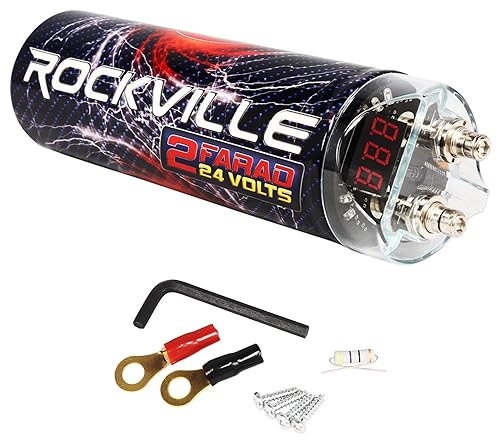
Rockville RXC2D 2 farad
$39.95A 2 farad capacitor for a larger system than a single 1 farad unit is typically sized for, though the added capacitance still follows the same honest limits covered below.
Check price on Amazon
Belva BB2D 2.0 farad
$54.99A 2 farad capacitor for a higher-power build, positioned as the larger option in Belva's capacitor lineup for anyone running multiple amplifiers off one charging system.
Check price on Amazon
NVX XCAP1F true 1.0 farad
$109.99Marketed specifically as a true 1 farad unit rather than an inflated rating, and it includes a built-in distribution block, which is a genuinely useful install feature at its $109.99 price.
Check price on AmazonFrequently asked questions
- Does a capacitor add power to my car audio system?
- No. A capacitor stores a small amount of energy and releases it quickly, but it doesn't generate power or increase your vehicle's charging capacity. A 1 farad capacitor at 14.4 volts stores roughly 104 joules, which a 1000 watt amplifier consumes in about a tenth of a second under real load. It's a brief buffer, not an additional power source.
- How big a capacitor do I need for my amplifier?
- The widely repeated "1 farad per 1000 watts" rule is a car audio convention, not an engineering standard backed by the physics of how quickly a capacitor actually discharges under load. If you're using a capacitor at all, size it based on your amplifier's power and installation, but understand that its role is smoothing brief spikes near the amp, not scaling proportionally to solve a bigger charging problem.
- Will a capacitor stop my headlights from dimming?
- Probably not, if the dimming is sustained rather than a brief flicker. A capacitor's stored energy lasts a fraction of a second under real amplifier load, so it can't compensate for a charging system that's genuinely undersized for continuous bass demand. A big 3 upgrade, a second battery, or a higher output alternator address sustained dimming far more effectively than a capacitor does.
- What should I upgrade before buying a capacitor?
- Start with a big 3 upgrade to your factory charging wires, since factory-gauge alternator, ground, and battery cables are often a bottleneck. If that doesn't resolve dimming or voltage sag, a second battery adds sustained reserve capacity, and a higher output alternator addresses ongoing demand at the source. A capacitor is worth considering only after those steps, for a narrow, brief-spike use case.
- Does a capacitor's display screen affect performance?
- No. A voltage display is a convenience feature that shows the capacitor's current charge level, but it doesn't change the unit's capacitance or how it performs electrically. If two capacitors have the same true farad rating, one with a display and one without will perform identically; you're only paying extra for the readout, not for better performance.
- Can a capacitor replace a second battery?
- No. A capacitor discharges its stored energy in a fraction of a second under real amplifier load, while a second battery provides sustained current capacity over the length of a song or a whole drive. They solve different problems: a capacitor smooths an instantaneous spike near the amp, while a second battery adds real reserve capacity to the vehicle's overall electrical system.
Researched guidance, not professional advice. This list reflects published manufacturer specifications and standard physics calculations, not our own bench measurements of any capacitor's actual capacitance. If you're dealing with dimming lights or voltage sag, have a professional check your charging system before assuming a capacitor is the fix, since the underlying cause is usually the alternator, battery, or wiring, not a lack of a capacitor.