Speakers
Best 6.5 Inch Component Speakers (2026)
Researched from published physics, alignment relations and manufacturer specifications. Updated .
Quick answer
A 6.5 inch component speaker set splits the job a single coaxial driver tries to do alone. The woofer handles bass and midrange from a door or kick panel mount, the tweeter handles the high end from its own separate mounting point, usually up near the dash or a pillar, and a passive crossover between them divides the signal so each driver only plays the frequencies it was built for. That separation is the entire reason component sets exist, and it is why they are the upgrade path most installers reach for first when someone wants a noticeably better sound stage rather than just louder highs.
The specific difference a component set makes is imaging, meaning how clearly the sound stage seems to sit up in front of the listener instead of down at ankle level. A coaxial speaker mounts its tweeter directly on top of the woofer, so both drivers fire from wherever the factory put the door speaker, usually low and off to the side. A component tweeter can be aimed up toward the windshield or across the dash, closer to ear height, which is what actually creates the sense of a stage rather than sound simply coming from the floor. The six sets below are grouped by budget and installation complexity, not by brand name alone.
How we chose these 6.5 inch component sets
Every set on this page was chosen from published manufacturer specifications, brand reputation, and how each set is actually discussed by installers and owners, not from a listening session in our own vehicle. We did not test these speakers in person, and we did not install any of them ourselves. What we can verify is whether a manufacturer publishes real specifications, such as a crossover point and an RMS power rating, rather than only a peak or max wattage figure meant to look impressive on a box. Sets that hide their real numbers behind marketing language were passed over in favor of ones that publish something a buyer can actually check.
Why a component set images better than a coaxial
Placement is the whole story. A coaxial speaker mounts the tweeter directly on the woofer's frame, so both drivers fire from wherever the factory put the door speaker location, which in most vehicles is low and angled away from the listener. A component tweeter is a separate small driver that mounts wherever there is room, commonly a sail panel, an A-pillar pod, or a factory tweeter location higher up on the dash. Moving the high frequencies up toward ear level is what creates the sensation of a stage in front of the listener instead of sound seeming to rise up from the floor. This is also why a cheaper component set can sometimes out-image an expensive coaxial: the improvement is largely about where the tweeter physically sits, not just how much the set costs.
RMS power vs peak power: read the label correctly
A speaker box that advertises a large peak or max wattage number is describing a brief, momentary figure the driver can survive for an instant, not what it plays continuously. RMS power is the continuous rating, and it is the one that should be matched against an amplifier's actual output. CTA-2006 is the published industry standard for measuring amplifier power honestly, and pairing an amplifier that is CTA-2006 rated with a speaker's published RMS figure, rather than its peak figure, is the only comparison that actually means something. A set that only lists a peak number and no RMS number is not necessarily a bad speaker, but the listing is telling a buyer less than one that publishes both.
Why doubling power barely doubles loudness
| Power change | Gain in decibels | What it sounds like |
|---|---|---|
| 2x power (for example 50W to 100W) | +3 dB | A small, just-noticeable step up |
| 4x power (for example 50W to 200W) | +6 dB | A clearly noticeable increase |
| 10x power (for example 50W to 500W) | +10 dB | Roughly a doubling of perceived loudness |
Published figure Source: Standard acoustic power-to-decibel relationship (10 times the base-10 logarithm of the power ratio).. This is why a few dB of sensitivity difference between two speakers usually matters more than a big gap in wattage rating, and why chasing peak power numbers is rarely the best use of a budget.
Buying tips
- Deaden the door before upgrading the speaker if the factory door panel flexes or buzzes at higher volume, since a door skin that flexes cancels out part of the output the speaker itself is producing.
- Check the tweeter mounting location the set includes or requires before buying, since a set with only a flush tweeter cup may not fit an A-pillar pod without an adapter.
- Match the RMS power rating to the amplifier's continuous output, not to its peak number, and remember an amplifier that is CTA-2006 rated is reporting an honest continuous figure.
- Confirm the woofer's mounting depth and basket diameter against the door before ordering, since a 6.5 inch nominal size still varies enough between brands to matter.
- Budget for the crossover's physical space. A passive crossover network needs to mount somewhere dry and out of the way, and that space is easy to forget when planning a door install.
A word on fitment
Do not assume any 6.5 inch component set will drop into a specific vehicle. Speaker depth, basket diameter, and factory wiring connectors vary enough between makes and models that fitment always needs to be checked against the actual door and dash of the vehicle in question, not just the nominal 6.5 inch size printed on the box.
Installing a component set: what actually changes versus a coaxial swap
Swapping a factory speaker for a coaxial driver is close to a bolt-in job: the new speaker goes where the old one came out, the factory connector plugs in or adapts easily, and the job is done. A component set adds two more decisions an installer has to make. The first is where the tweeter physically goes, since it does not have to live in the same location as the woofer, and a sail panel mount, an A-pillar pod, or a factory tweeter grille higher on the dash are all common answers depending on the vehicle. The second is where the crossover mounts, since it needs a dry, out-of-the-way spot with enough room for its enclosure, commonly inside the door itself or tucked behind a kick panel.
Neither decision is difficult, but both take more planning than a straight coaxial swap does, which is worth knowing before starting the job on a weekend afternoon with a hard stop. Running a separate wire pair from the crossover output to the tweeter's new location, rather than the door, is the one extra wiring run a component install adds over a coaxial one. Budgeting an extra hour or two for that wire run and the tweeter mount is realistic for a first-time component install.
The picks, by tier

Recoil REM65 Echo
$46.99An inexpensive way to try a real component set for the first time, with a separate tweeter and crossover at a price close to a basic coaxial upgrade.
Check price on Amazon
Rockford Fosgate Prime R165-S
$79.99A genuine crossover and separate tweeter from a brand that publishes real specifications, at a price close to a plain coaxial upgrade.
Check price on Amazon
Orion Cobalt CB65C
$89.95A step up in crossover parts and tweeter quality from the beginner tier, aimed at a listener who already knows they want the imaging benefit of a component set.
Check price on Amazon
Pioneer TS-A1601C
$120.95Pioneer's mid-tier component line, built on the same A-series tuning the brand uses across its coaxial and 6x9 speakers for a more consistent front stage.
Check price on Amazon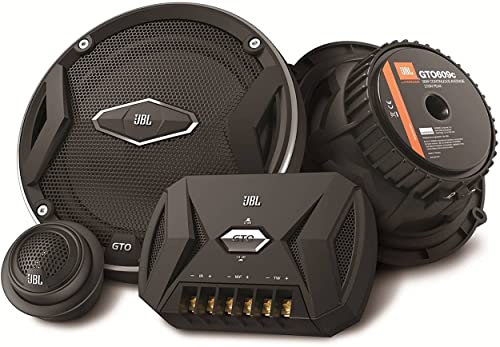
JBL GTO609C
$134.95Uses JBL's Plus One cone design to fit a larger effective cone area into the same mounting depth, aimed at buyers who have already outgrown a mid-tier set.
Check price on Amazon
Pioneer TS-A653CH
$148.97Pioneer's higher component tier, for a buyer who wants a more refined crossover network and tweeter than the mid-range A1601C without moving to a specialty brand.
Check price on AmazonFrequently asked questions
- What is the actual difference between a component speaker set and a coaxial speaker?
- A component set separates the tweeter from the woofer and routes the signal between them through a dedicated crossover, so the tweeter can be mounted wherever it images best, often up near the dash. A coaxial speaker builds the tweeter directly onto the woofer's frame, so both drivers are stuck at whatever location the factory speaker mount happens to be, usually low in the door.
- Do I need an amplifier to run a 6.5 inch component set?
- No, a component set will play directly off a head unit's built-in amplifier the same way a coaxial speaker does, since a passive crossover does not require external power. An amplifier improves headroom and control, especially on a set with a higher RMS rating, but it is an upgrade rather than a requirement to get sound out of the drivers.
- Why does the crossover matter in a component speaker set?
- The crossover divides the incoming signal so the woofer only receives the low and midrange frequencies it can handle cleanly and the tweeter only receives the highs it was built for. Without it, both drivers would try to reproduce the entire frequency range, which strains the tweeter with bass it cannot handle and muddies the woofer with highs it reproduces poorly.
- Should I deaden the door before or after installing new component speakers?
- Before, if the budget allows it. A door panel that flexes and buzzes at higher volumes is canceling out part of the new speaker's own output before it ever reaches the cabin, so deadening the door first usually produces a bigger improvement per dollar than the speaker upgrade alone. If the budget only allows one step right now, deadening is often the better first purchase.
- Will a component set fit in my factory door speaker location?
- It depends on the vehicle, and it is not something to assume from the 6.5 inch nominal size alone. Mounting depth, basket diameter, and the factory wiring connector all vary between makes and models, so check the woofer's actual dimensions and the tweeter's mounting requirements against the door and dash before ordering rather than after.
- Is peak wattage or RMS wattage more important when comparing component speakers?
- RMS wattage is the continuous rating, and it is the one that should be compared against an amplifier's actual continuous output. Peak or max wattage describes a brief, momentary figure the driver can survive for an instant, and it is largely a marketing number. A published RMS rating is a far more honest way to judge how a set will actually perform.
Researched guidance, not professional advice. Specifications and prices come from manufacturer listings and are worth confirming again before buying, since both change over time. Always check mounting depth and tweeter placement against the actual vehicle rather than assuming any 6.5 inch set is a universal fit.