Electrical
What Size Fuse for a 500 Watt Amplifier?
Researched from published physics, alignment relations and manufacturer specifications. Updated .
Quick answer
The fuse question has a short answer and a reason that matters more than the answer. The short answer: a 500 watt RMS class D amplifier draws about 43.4 amps, and the fuse is sized to whatever the power wire can carry, not to the amplifier.
The reason: a fuse protects the wire. Its job is to open before the cable can get hot enough to start a fire. The amplifier already has its own onboard fuses and those protect the amplifier. This is why the answer changes when you change the wire and not when you change the amplifier, and it is why fitting a 300 amp fuse on 4 gauge wire is dangerous even though it sounds generous.
Run your own figures through the fuse size calculator.
How many amps does a 500 watt amp draw?
Current draw is RMS watts / (efficiency x volts). At 500 watts, 80 percent efficiency and 14.4 volts, that is 43.4 amps. In a class A/B amplifier at around 55 percent efficiency, the same rated power draws about 63.1 amps, which is why class A/B amplifiers need so much more wire for the same output.
Both efficiency figures are conventions rather than published specifications. No standards body publishes a single efficiency number for a mobile amplifier, because it varies with load impedance, output level and the amplifier itself. Where a manufacturer publishes a current draw figure of its own, use that instead.
Fuse size by wire gauge at 43.4 amps
The fuse follows the wire. Find your conductor size in the left column, and the fuse is the smallest standard value that both passes 43.4 amps and stays within the conductor's ampacity.
| Wire size | Ampacity | Fuse |
|---|---|---|
| 8 gauge | 50 A | 50 A |
| 6 gauge | 65 A | 50 A |
| 4 gauge | 85 A | 50 A |
| 2 gauge | 115 A | 50 A |
| 1 gauge | 130 A | 50 A |
| 1/0 gauge | 150 A | 50 A |
| 2/0 gauge | 175 A | 50 A |
| 4/0 gauge | 230 A | 50 A |
Published figure Source: NEC Table 310.16, 75 C copper. Overcurrent protection sizes to the conductor, not the load. The same principle as NEC 240.4: a fuse protects the wire it is connected to. Where a conductor cannot carry the draw, there is no correct fuse for it at this power. That is the table telling you to use larger wire rather than a larger fuse.
Why the fuse goes within 18 inches of the battery
This is the single most important rule in a 12V install. Every inch of cable between the battery positive terminal and the fuse is unprotected. If that length chafes through on a body seam or gets crushed when someone closes the hood on it, the battery will push several hundred amps through the short, and the cable will glow before anything stops it. Eighteen inches is the figure published in mobile electronics installation practice, and shorter is better.
ANL, MIDI and AGU, and which to use
ANL fuses are the large blade-style fuses used for main runs from about 80 amps upward, and they are what belongs at the battery on any serious system. MIDI, also sold as mini-ANL or AFS, covers roughly 30 to 200 amps in a much smaller holder, which is what fits on a 4 or 8 gauge run where an ANL holder will not. AGU is the old glass tube fuse and it is worth avoiding on anything substantial: the end caps corrode, the contact resistance rises, and the holder gets hot long before the fuse opens.
Whichever type you use, the holder matters as much as the fuse. A holder that will not clamp your conductor properly is a resistance heater sitting in line with your main run.

NVX XMFH48 mini-ANL holder
$9.99Forged brass in a small package, for an 8 or 4 gauge run where an ANL holder will not fit.
Check price on Amazon
BOJACK ANL holder with 300A fuse
$9.99A complete inline ANL holder and fuse at under ten dollars, which removes every excuse for skipping the main fuse.
Check price on Amazon
BOJACK 100A ANL holders, 2 pack
$11.99Two holders and two 100 amp fuses, which suits a pair of small amplifiers fused separately.
Check price on Amazon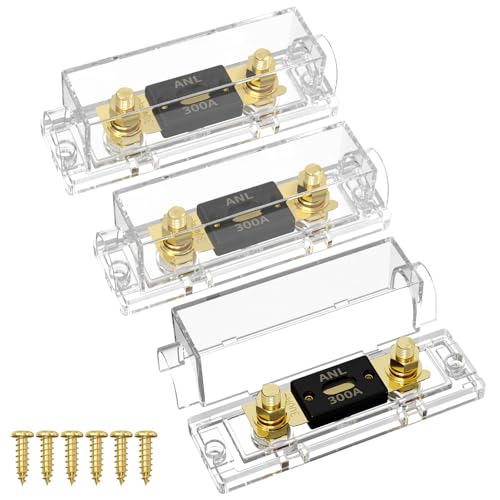
Joinfworld 300A ANL holders, 3 pack
$12.55Three holders, which covers the battery end, the distribution end and a spare.
Check price on AmazonFusing more than one amplifier
Two fuses, in two places, doing two different jobs. The main fuse at the battery protects the single large run from the battery to the distribution block, and it is sized to that run's conductor. A second fuse on each output of the distribution block protects each smaller run to each amplifier, sized to that smaller conductor.
Without the second stage, a short in the thin run to a small amplifier is protected only by the large main fuse, which will never open in time to matter. A fused distribution block does both jobs in one part.

Recoil DB12 two way
$9.99The cheapest block from a named brand, for splitting one run to two amplifiers.
Check price on Amazon
Recoil SDB12P mini block, 2 pack
$12.99Two blocks, so power and ground both get one, which is how it should be done.
Check price on Amazon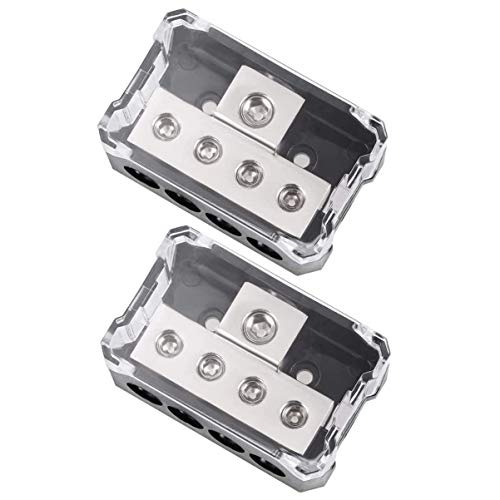
VonSom four way block
$14.99One 1/0 input to four outputs, for a rack with several amplifiers.
Check price on AmazonFuse holders for this system
NVX XMFH48 mini-ANL holder
$9.99Forged brass in a small package, for an 8 or 4 gauge run where an ANL holder will not fit.
Check price on Amazon BOJACK ANL holder with 300A fuse
$9.99A complete inline ANL holder and fuse at under ten dollars, which removes every excuse for skipping the main fuse.
Check price on Amazon BOJACK 100A ANL holders, 2 pack
$11.99Two holders and two 100 amp fuses, which suits a pair of small amplifiers fused separately.
Check price on Amazon Joinfworld 300A ANL holders, 3 pack
$12.55Three holders, which covers the battery end, the distribution end and a spare.
Check price on AmazonFrequently asked questions
- What size fuse does a 500 watt amp need?
- On 8 gauge wire, a 50 amp fuse. The amplifier draws about 43.4 amps at rated output, and 50 amps is the smallest standard value that passes that load while staying within what 8 gauge can carry. Change the wire size and the correct fuse changes with it, because the fuse protects the wire.
- Should the fuse match the amplifier onboard fuses?
- Only if the wire can carry that total. Adding up the amplifier's onboard fuses is a common shortcut and it is right only when the conductor supports the sum. If your amplifier carries two 40 amp fuses and your power wire is 8 gauge, an 80 amp main fuse exceeds what many 8 gauge runs should carry. The conductor decides, always.
- Does a bigger fuse give my amplifier more power?
- No. A fuse is not a restriction in normal operation; it passes whatever current flows until it opens. Fitting a larger fuse changes nothing about performance and removes protection from the wire. If an appropriately sized fuse keeps blowing, that is a fault to diagnose rather than a fuse to upsize, and the usual causes are a low impedance load or a short at the speaker terminals.
- Do I need a fuse on the ground wire?
- No, and you should not fit one. The ground wire connects to the chassis, which is already at battery negative potential, so there is no voltage across a break in it and nothing for a fuse to protect against. A fuse there adds resistance to the return path for no benefit. Fusing is for conductors that are live relative to the body.
- Can I use a circuit breaker instead of a fuse?
- Yes, provided it is rated for the current and for 12 volt DC rather than only for AC. A resettable breaker is genuinely convenient on a system that gets worked on often, because it doubles as a battery disconnect. The trade is that breakers generally have higher contact resistance than a good ANL fuse holder and they can nuisance trip when hot.
12V safety. A car battery will deliver several hundred amps into a short circuit without any drama at all, which is why the main fuse goes within 18 inches of the battery positive terminal. That fuse protects the wire, not the equipment: the length of cable between the battery and the fuse is unprotected, so a fuse at the amplifier end protects nothing. Disconnect the battery negative before you run power wire, and fit a rubber grommet anywhere a cable passes through sheet metal, because a bare edge will eventually cut through insulation.